Can You Freeze Chicken Breast?
The family-pack special is only a bargain if you can use it in time, and the freezer is how you win. Raw chicken breast is one of the most reliable things you can put on ice — it keeps its mild flavor for months and goes from solid to pan-ready overnight in the refrigerator.
Also called: boneless skinless chicken breasts · chicken breasts · raw chicken breast
Yes — raw chicken breast freezes for 9–12 months and cooks much like fresh after thawing, with only slight moisture loss.
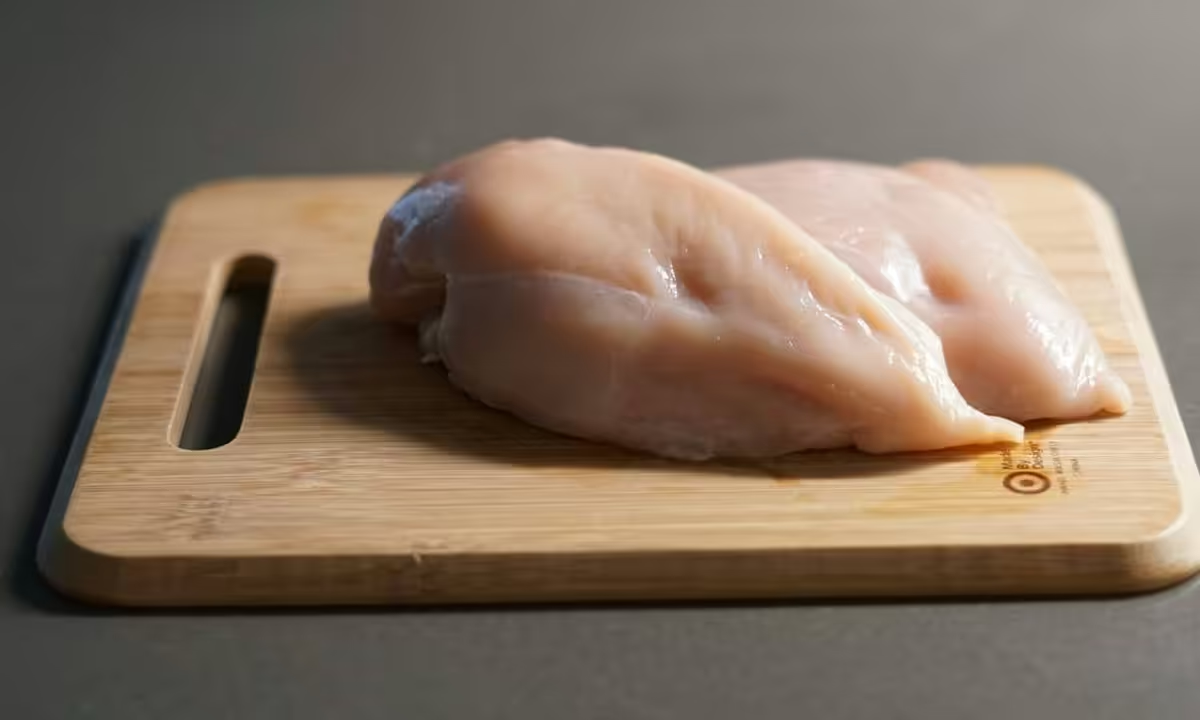
Freezing chicken breast the right way
Wrap each breast individually, then bag meal portions flat with the air pressed out. Flat packs thaw overnight in the refrigerator and stack like books, so you pull exactly one dinner's worth at a time.
Before it goes in
- Pat the breasts dry — surface moisture becomes ice crystals that dry the meat.
- Wrap each breast tightly in freezer paper or plastic wrap pressed to the surface.
- Portion meal-sized amounts into freezer bags, pressing out every bit of air.
- Flatten the bags so the meat is about an inch thick for fast, even thawing.
- Label with the cut and date, then freeze flat until solid.
Containers & wrapping
Skip the supermarket tray — the film on store packaging lets air through. Freezer paper, vacuum bags, or heavy freezer bags are the standard; a vacuum seal buys the longest quality run.
Freezer storage
9–12 months
FoodKeeper-style guidance puts raw chicken pieces at nine months to a year for quality. Food kept solidly frozen at 0 °F / -18 °C stays safe indefinitely — the clock only measures texture.
Keep the freezer at 0 °F / -18 °C and safety stops being a question for chicken breast. What the calendar measures is quality: past its window it is safe, only a step further from fresh.
Thawing chicken breast: the practical method
Thaw in the refrigerator overnight — a thick breast needs about 12 hours. In a hurry, seal it in a leakproof bag and submerge it in cold water, changing the water every 30 minutes. Never thaw chicken on the counter.
Can chicken breast be thawed and refrozen safely?
Yes, if it thawed in the refrigerator and stayed cold — quality drops a notch but it is safe. Never refreeze chicken that warmed up on the counter; cook it through instead.
Texture & flavor changes
Thawed breast releases a little more moisture when cooked and can be marginally less tender than fresh, mostly because ice crystals puncture muscle cells. A quick brine before cooking, or a sauced dish, makes the difference hard to find.
Best uses after thawing
Where thawed chicken breast shines:
- Sheet-pan dinners
- Stir-fries
- Chicken soup
- Breaded cutlets
- Curries
Which version do you have?
All versions freeze for the same window. Skin-on pieces shield the meat slightly from drying; bone-in breasts take longer to thaw. Freeze them whichever way you actually cook them.
Caveats worth knowing
- White frost patches are freezer burn — a quality problem, not a safety one. Trim the dry spots and cook as planned.
- Do not freeze chicken that is already at its date's edge; freezing pauses spoilage, it never rewinds it.
- A loose wrap shows up fast here: unwrapped or poorly sealed breasts develop freezer burn within a couple of months.
Freezer FAQs for chicken breast
Can you freeze raw chicken?
Yes — raw chicken breast freezes for 9–12 months at best quality, and chicken kept solidly frozen at 0 °F / -18 °C stays safe indefinitely. The window measures texture: very old packages dry out and turn mealy sooner. Wrap tightly, press the air out, and freeze flat.
Can you refreeze raw chicken after thawing it in the fridge?
Yes, as long as it thawed in the refrigerator and never warmed up. Expect more moisture loss when you cook it, so lean toward soups, shredding, or sauced dishes. Chicken that sat out or thawed for hours in warm water should be cooked through and eaten, not refrozen.
How do you thaw frozen chicken breasts quickly?
Cold water, never the counter. Seal the breast in a leakproof bag, submerge it in cold water, and change the water every 30 minutes — a breast thaws in an hour or two. Cook immediately afterward. The refrigerator method is slower but gives you a day or two of grace.
The details that decide it
Between minus one and minus five, most of the water turns solid, and that band sets the damage
A breast is about three-quarters water, held as free, immobilised and bound fractions, and almost all of what can freeze does so across a narrow thermal band. Reviews of frozen meat call the span from roughly minus one to minus five degrees the zone of maximum ice formation, because free and loosely held water crystallises there while the tightly bound fraction stays liquid. How fast the tissue crosses that band decides the crystals: rapid freezing yields many small, uniform ones, and slow freezing yields fewer, larger ones that push apart and rupture the fibre network. The collapse is mechanical before it is chemical. Water driven out of the myofibrils into the spaces between them is not fully taken back when the ice melts, so the tissue cannot recover its original hold on water even before any protein has changed shape.
- Roughly minus one to minus five degrees is where most water becomes ice.
- Fast crossing gives small uniform crystals; slow crossing gives large ones.
- Water forced out of the myofibrils is not fully reabsorbed on thawing.
Five trips through the freezer cut how much protein your body can pull back out
Repeated freezing is where a breast loses more than juice. The ice crystals of each cycle derange the myofibrillar proteins enough that their ordered alpha-helix unwinds toward a random coil, burying the water-binding chemistry inside and exposing greasy residues to the solvent. That unfolding also builds aggregates, and aggregates hide the peptide bonds that stomach and pancreatic enzymes need to reach. In a study that carried chicken breast through five freeze-thaw cycles, the authors recorded digestibility falling step by step: gastric digestion was down almost twenty-six percent and digestion across the whole gut down nearly twelve percent versus never-frozen muscle, with shear force climbing as the meat got harder to chew. The freezer does not add a contaminant; it rearranges the protein so your enzymes get less of it.
- Alpha-helices unwind toward random coils through freeze-thaw cycling.
- Aggregated protein hides the peptide bonds digestive enzymes need.
- Across five cycles, gastric digestibility fell about 26 percent.
The thaw is the second half of the loss, and the drip carries the colour with it
Most of what a frozen breast surrenders it surrenders while warming. Studies on slowly frozen breast name thawing time and drip loss as the two strongest contributors to the oxidative damage measured afterward, and the reason is timing: a long thaw keeps the outer tissue warm and enzyme-active for hours before the centre is soft. That exudate is not plain water. Reviews of frozen muscle describe drip as carrying soluble vitamins, proteins and lipids out of the tissue, and once cells have been torn it also mobilises heme iron, the very pro-oxidant that drives rancidity. Myoglobin leaks with the same fluid, so the palest, wettest part of a thawed breast is often the least coloured. Nutritious as the drip is, it also feeds bacteria, which is why catching it in a bag beats mopping it off the board.
- A long thaw keeps outer tissue enzyme-active before the centre softens.
- Drip carries soluble vitamins, proteins and lipids out of the meat.
- Myoglobin leaks with the drip, so colour leaves the wettest areas first.
Related foods