Can You Freeze Sausage?
Fresh sausage freezes the way it cooks: easily, with flavor to spare. The catch is the one bacon shares — sausage fat goes rancid before the meat spoils, so the window is short and the wrap must be airtight. Links, patties, or bulk, three to four months is the honest horizon.
Also called: italian sausage · breakfast sausage · brats · fresh sausage
Yes — fresh sausage freezes well for three to four months of quality; its fat needs an airtight wrap, same as bacon's.
Packing and freezing sausage
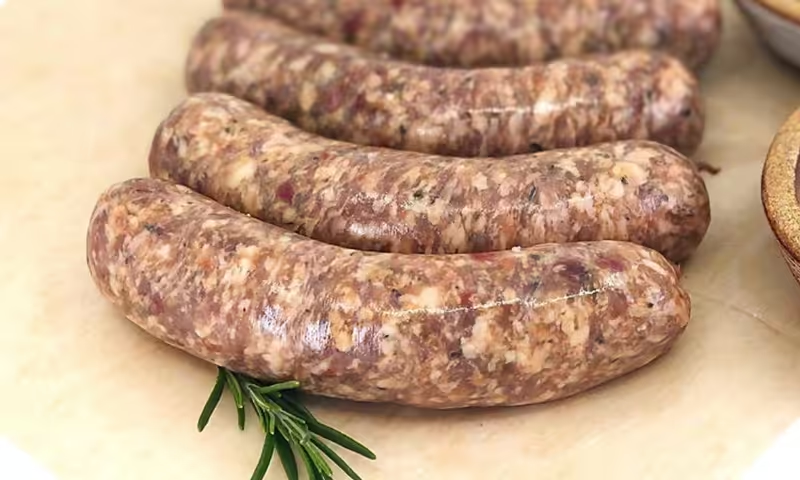
Freeze links and patties on a tray until solid, then bag so they stay separate; bag bulk sausage flat in meal portions. Airtight is non-negotiable — sausage fat is the first thing to fade.
Before it goes in
- Portion by meal: links in fours, patties in pairs, bulk in half-pounds.
- Freeze individual pieces on a tray first so they do not fuse.
- Bag with the air pressed out, or wrap tightly in freezer paper.
- Label with the type and date — breakfast and Italian look alike frozen.
Containers & wrapping
Freezer bags or vacuum bags; freezer paper for grill-bound links. The unopened vacuum pack from the store can go straight in. Air is the enemy — exposed fat picks up off flavors fast.
Freezer storage
3–4 months
Fresh sausage holds quality three to four months frozen — the fat, not the meat, sets the clock. It stays safe while frozen solid at 0 °F / -18 °C; rancidity is a flavor problem, not a safety one.
Keep the freezer at 0 °F / -18 °C and safety stops being a question for sausage. What the calendar measures is quality: past its window it is safe, only a step further from fresh.
How to defrost sausage
Refrigerator-thaw overnight, or separate frozen links and start them in a covered pan over low heat. Patties thaw in the refrigerator in a few hours. No counter thawing — this is still raw meat.
Does refreezing sausage change it in practice?
If it fridge-thawed and stayed cold, once is acceptable, with more off-flavor risk than in lean meat. Better to portion so the question stays hypothetical.
Texture & flavor changes
Thawed sausage cooks nearly identically — the casing and fat do their job. Very long storage dulls the spices and can nudge the fat toward rancid, so rotate within the window rather than testing it.
Best uses after thawing
Where thawed sausage shines:
- Pasta sauces
- Breakfast links and patties
- Jambalaya
- Sheet-pan meals
- Stuffing
Which version do you have?
Links freeze and cook whole; bulk freezes flat in slabs and thaws fastest. Both hold three to four months — freeze whichever form your recipes call for, not whichever happens to be at hand.
Caveats worth knowing
- Precooked sausages such as hot dogs and smoked sausage behave differently — shorter window, drier result; they get their own cards.
- Rancid fat smells waxy or crayon-like — if thawed sausage smells sharp rather than savory, discard it.
- Do not thaw raw sausage on the counter; the casing warms fast and the interior lags dangerously behind.
What people ask about freezing sausage
Can you freeze fresh sausage?
Yes — links, patties, and bulk all freeze for three to four months at best quality. Sausage fat goes rancid faster than the meat spoils, so airtight wrapping matters more than for lean cuts. Freeze pieces on a tray first so they stay separate, then bag.
How long can you freeze sausage?
Three to four months for best quality. It stays safe while frozen solid at 0 °F / -18 °C, but the fat can pick up waxy, stale flavors near the end of the window, so rotate your supply rather than stretching it.
Can you freeze sausages in their casings?
Yes — freeze the links flat in a single layer so the casings stay unbroken, then cook them straight from frozen.
The details that decide it
A sausage is an emulsion, so the freezer is working on two phases at once
A sausage is not a piece of muscle; it is a fabricated emulsion, typically chopped lean meat and back fat with added ice water and salt, in proportions such as seven parts lean to three parts fat and around twenty percent water. That structure matters because the freezer does not treat the phases identically. The protein gel holds the dispersed fat and the bound water, and the ice that forms does so in the water phase, expanding and pushing the network it is embedded in. Where a whole cut has fibre and fascia to absorb that pressure, an emulsion has only the gel, and gel strength varies with the fat it is carrying, the salt that solubilised the protein and the amount of added water. A high-fat sausage and a high-water sausage are therefore not the same freezing problem, even at the same recipe.
- A sausage is lean meat, back fat, water and salt in an emulsion.
- Ice forms in the water phase and presses on the protein gel around it.
- An emulsion has no fascia to absorb the pressure, only gel strength.
Each freeze-thaw cycle costs a cooked sausage water and adds oxidation
For a prepared meat product the cycle count is the variable that matters most. A study on cooked pork meat products took them through repeated freeze-thaw, freezing at minus eighteen for five days and thawing at four degrees for twelve hours per cycle, and repeated that three, five and seven times. The authors describe freezing and thawing as regulating the oxidation reaction of the meat system and driving water migration out of the mince, both of which degrade quality, and their additions worked by limiting that water migration and holding the oxidation in check. The lesson for a sausage is that a cooked product is not protected by having been cooked; the same two processes, oxidation and water movement, run on through every cycle, and the count compounds them.
- A standard cycle is five days at minus eighteen then thawing at four.
- Repeated cycles regulate oxidation and drive water migration in mince.
- Cooking does not protect a product from the cycling that follows.
The salt in a sausage moves where it freezes, which changes the calculation
Salt is not only a flavour or a preservative in a sausage; it changes the physical event you are trying to manage. As a sausage freezes, the dissolved salt and other solutes are concentrated into the shrinking unfrozen water, and reviews of crystallisation behaviour note that solutes substantially lower the temperature at which the water in a food freezes relative to pure water, with the size of the shift depending on both the concentration and the molecular weight of what is dissolved. A salty sausage therefore has a wider unfrozen window than a plain one, and process continues in that liquid fraction while the rest of the product is already hard. It is a quiet advantage in one sense, because some unfrozen water buffers the ice damage, but it also means the freezing point you read on a thermometer is not the temperature the product is actually changing at.
- Dissolved salt is concentrated into the shrinking unfrozen water.
- Solutes substantially lower the freezing point of water in a food.
- The shift depends on solute concentration and molecular weight.
Related foods