Can You Freeze Whole Chicken?
A whole bird is the freezer's low-maintenance guest: bones and skin act as built-in insulation, and standard guidance rewards it with a full twelve months of quality. Wrap it well, forget about it, and roast it when a hunger sized for a holiday arrives.
Also called: whole bird · roasting chicken · fryer chicken
Yes — a whole chicken freezes up to a year, the longest window of any cut, and roasts nearly like fresh.
Freezing whole chicken the right way
Keep the original wrapper and overwrap it in freezer paper or a large freezer bag — the store film alone is too permeable for long storage. Freeze breast-side down on the coldest shelf.
Before it goes in
- Remove the giblets if they came along — freeze those separately for stock.
- Overwrap the bird in freezer paper or slip the whole thing into a jumbo freezer bag.
- Press out air and seal; add a second wrap layer for anything past three months.
- Label with the weight and date — thaw time depends on size.
- Freeze flat on the coldest shelf for the fastest, safest freeze.
Containers & wrapping
Original packaging plus an overwrap of freezer paper, heavy foil, or a jumbo freezer bag. Vacuum bags are ideal if yours is big enough — an airtight bird shrugs off freezer burn for a year.
Freezer storage
12 months
A whole frozen chicken keeps top quality for up to a year — longer than any cut piece. Solidly frozen food stays safe at 0 °F / -18 °C; the year marks flavor, not safety.
The freezer stops the safety clock for whole chicken and only slows the quality one. At a steady 0 °F / -18 °C it stays safe while frozen, so the number on the label is about taste.
How to defrost whole chicken safely
Plan ahead: a 4-pound bird needs about a day in the refrigerator, larger birds up to two. Keep it bagged on a tray to catch drips. Cook within a day of thawing.
Is refreezing whole chicken allowed without risk?
Only if it thawed in the refrigerator and is still cold and fresh-thawed. Refrozen whole birds lean toward stock and shredded uses, since the second freeze dries the exterior.
Texture & flavor changes
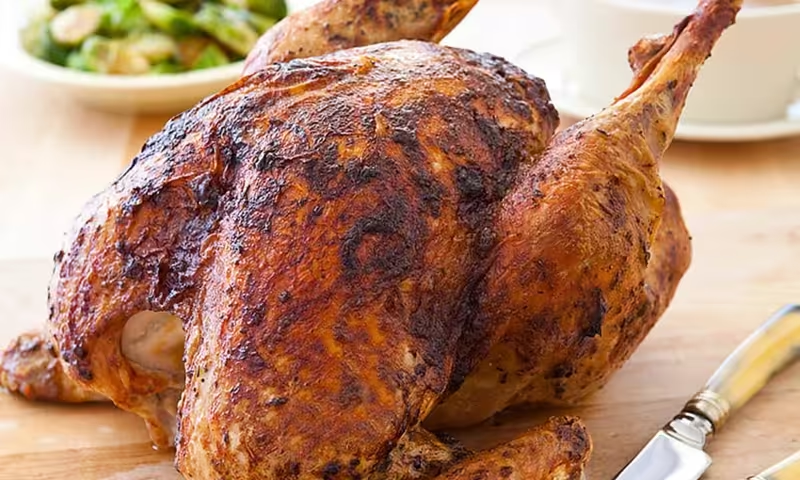
The roasted result is remarkably close to fresh — slightly looser skin and a bit more juice in the pan. Because the bird roasts whole, the freezer has little surface to damage, which is why it outlasts cut pieces.
Best uses after thawing
Where thawed whole chicken shines:
- Roast chicken
- Chicken stock
- Chicken noodle soup
- Shredded chicken
- Chicken pot pie
Which version do you have?
A whole bird earns its twelve months; an already-cut bird is easier to portion but hogs bag space. If freezer room is tight, quarter the bird and freeze in meal packs — quality stays in the 9–12 month range.
Caveats worth knowing
- Never thaw a whole bird on the counter — the outer layer enters the danger zone hours before the center budges.
- A 6-pound bird takes two full days to fridge-thaw; check the calendar before you plan Sunday dinner.
- Giblets freeze separately and only for 3–4 months of quality — use them for stock before the bird itself.
Whole Chicken: questions about the freezer
How long can a whole chicken stay in the freezer?
Up to twelve months at best quality — the longest of any chicken cut, thanks to the protective bones and skin. It remains safe indefinitely while frozen solid at 0 °F / -18 °C, but flavor and juiciness fade toward the end of the year.
Can you cook a whole chicken from frozen?
Yes — the oven (never the slow cooker) is the safe route. Roast at a steady temperature, allow roughly 50% more time, and confirm the thickest part of the thigh and the cavity reach 165 °F. Skip the stuffing and cook it separately.
How do you portion a whole chicken before freezing?
Joint it into thighs, breasts and wings first; frozen whole, the bird thaws at the crown last and dries there first.
The details that decide it
Freezing a whole chicken changes its flavour far less than the breed of bird already did
The worry about freezing poultry is that it comes back tasting of the freezer, and on the evidence flavour is the part the freezer leaves most alone. Breast meat from Korean native chickens and from commercial broilers was frozen quickly and slowly and then thawed, and compared against fresh meat on physicochemical, sensory and volatile measures. Fresh and thawed meat could not be separated on flavour regardless of which freezing rate had been used, while plenty of volatile compounds did separate the two breeds from each other. Breed also outweighed the freezer on the quality measures that did move, so the bird you started with did more to the result than the speed of the freeze. The authors read the flavour finding as a stability result, and their recommendation is to look at longer storage windows rather than to distrust the freezer.
- Fresh and thawed chicken breast scored the same on flavour at both freezing rates.
- Volatile markers separated the breeds from each other, not frozen from fresh.
- Breed affected the measured quality more than the freezing method did.
Five ways to thaw a chicken fillet, ranked by what each one leaves behind
Chicken fillets were frozen and then thawed five ways, and the routines were compared on water loss, oxidation, microbiology and a tasting panel. Water immersion at fifteen degrees for thirty minutes was the quickest and the harshest on water; low-temperature thawing at zero to four degrees for four hours was the gentlest and the slowest; two combined routines paired a brief warm step with a long cold one. Every quality marker moved the same way once the meat had been frozen and thawed: shear force rose, thawing loss rose, protein and lipid oxidation rose, while pH and protein solubility fell. The combined routines came out ahead of the single-step ones, and an oven thaw scored best of all with the panel, but the authors rule it out commercially because of how slowly it has to run and how long the surface spends warm. The honest conclusion is that no thaw restores a fresh fillet; the best of them loses the least.
- Shear force, thawing loss and both protein and lipid oxidation rose in every thawed sample.
- pH and protein solubility fell after freezing and thawing.
- The combined and oven routines scored best, though the oven thaw was judged impractical at scale.
Most households thaw a whole chicken in the one place the food-safety advice tells them not to
A survey of households that freeze raw chicken, paired with laboratory thawing of breast meat, gives a picture of what actually happens in kitchens. More than eight in ten of those who stored chicken at all put some of it in the freezer, and the single most common way to defrost it was on the kitchen counter, at almost a third of the answers, with the refrigerator next at about a quarter and warm water, the microwave and tap water behind it. Measured drip loss told a different story from habit: refrigerator thawing lost the least at about zero point six percent, warm water and tap water sat around one, counter thawing about one and a half, and the microwave far more at nearly three and a half. Only the refrigerator, cold water and the microwave are endorsed as safe; the counter and hot water are not among them.
- Counter thawing was the most common household choice, at about a third of the answers.
- Refrigerator thawing lost about zero point six percent drip against nearly three and a half for the microwave.
- Cooking loss was lowest for the microwave and refrigerator and highest for the water thaws.
Related foods