Can You Freeze Breast Milk?
Breast milk is the one milk the freezer was unambiguously made for. Pumping parents have banked milk in chest freezers for generations, and pediatric guidance is settled on the method: small portions, food-grade storage bags, labeled dates. What matters here is not whether to freeze — it is handling the milk cleanly on the way in and the way out.
Also called: human milk · pumped milk · expressed breast milk · freezing breast milk
Yes — breast milk freezes beautifully for about six months; this is standard, recommended practice for pumped milk.
Best way to freeze breast milk
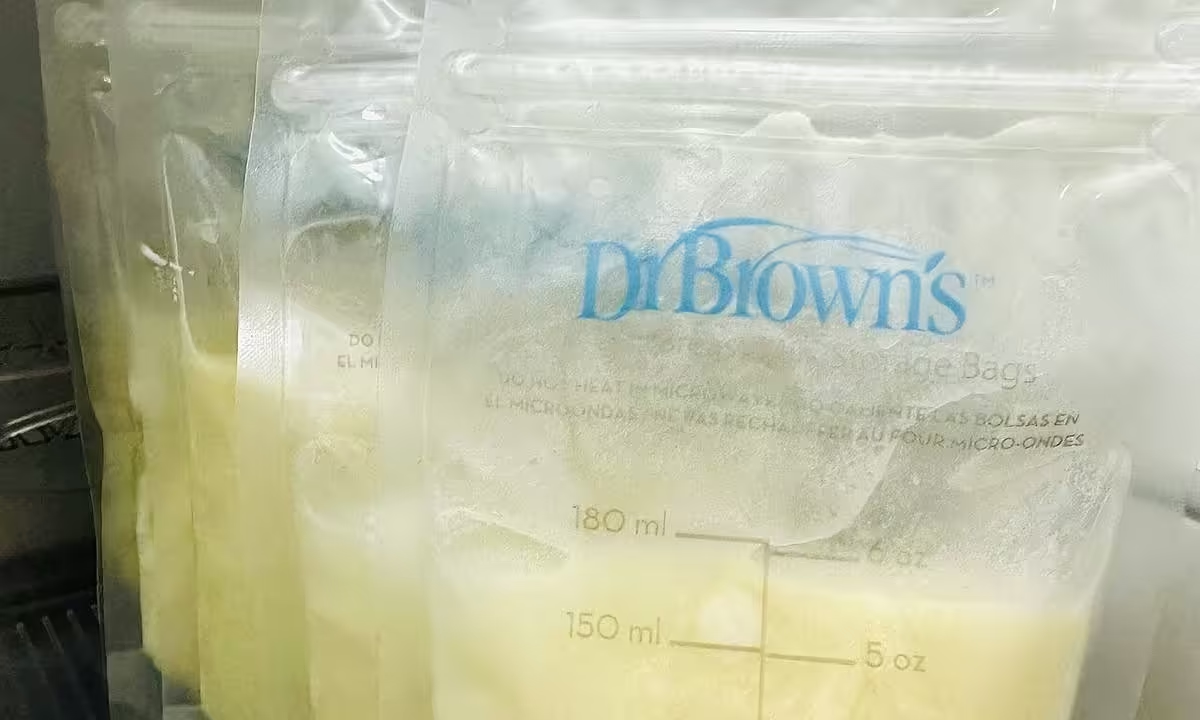
Express with clean hands into food-grade breast-milk storage bags or hard containers, cool the milk in the refrigerator first, then freeze in two-to-four-ounce portions with headroom for expansion. Small portions waste nothing, because a thawed bag never goes back.
Before it goes in
- Wash hands and use clean, food-grade breast-milk storage bags or rigid containers.
- Cool freshly pumped milk in the refrigerator before it goes into the freezer.
- Portion in two-to-four-ounce amounts — the size of a typical feed, plus a little.
- Leave an inch of headroom; milk expands as it freezes.
- Label every bag with the date, and place the oldest milk where you will grab it first.
Containers & wrapping
Purpose-made breast-milk storage bags or hard-sided food-grade containers with tight lids. Regular sandwich bags and bottles meant for feeding are not designed for the freezer.
Freezer storage
6 months
Pediatric guidance (CDC) puts best quality at about six months in a standard freezer, up to twelve in a deep freezer at 0 °F / -18 °C. Fat rises to the top of stored milk — that separation is normal, and a gentle swirl brings it back together.
The freezer stops the safety clock for breast milk and only slows the quality one. At a steady 0 °F / -18 °C it stays safe while frozen, so the number on the label is about taste.
Thawing breast milk: the practical method
Thaw the oldest bag first, overnight in the refrigerator, or hold it under cool then warm running water. Never microwave — hot spots can scald a baby and destroy immune components. Swirl gently to recombine the fat; shaking hard is unnecessary.
Does refreezing breast milk change it without risk?
No. Milk that has fully thawed stays thawed — use it within twenty-four hours of thawing in the refrigerator. Milk left over from a finished feed should be used within two hours or discarded.
Texture & flavor changes
Thawed breast milk can smell soapy or metallic even when perfectly safe — an enzyme (lipase) keeps breaking down fat after expression. Some babies mind the taste, others never notice; scalding fresh milk before freezing prevents it for the next batch.
Best uses after thawing
Where thawed breast milk shines:
- Direct feeding
- Mixing with solids
- Bottle feeds
- Milk baths
Which version are you freezing?
Freshly pumped milk can be combined with refrigerated milk of the same day before freezing. Previously frozen milk never returns to the freezer, and leftover milk from a feed is a use-now-or-toss situation.
Caveats worth knowing
- Never microwave breast milk or warm it directly on the stove — uneven heat destroys nutrients and creates scald spots.
- Thawed milk has a hard stop: twenty-four hours in the refrigerator, two hours at room temperature after a feed begins. When in doubt, discard — unlike adult food, the stakes here are a tiny immune system.
- If thawed milk smells rancid rather than soapy, or the baby refuses it repeatedly, discard the batch and scald future milk before freezing.
Questions about breast milk in the freezer
How long can you freeze breast milk?
Six months is the quality benchmark in a standard freezer, and deep freezers held at 0 °F / -18 °C stretch that to twelve. Milk stays safe while solidly frozen, but immune components and fats fade slowly — use the oldest bags first and date everything.
Can you refreeze thawed breast milk?
No. Once thawed, use it within twenty-four hours if kept in the refrigerator. Refreezing costs quality and, more importantly, adds handling cycles that raise contamination risk. Portion small so a bag is always a single feed.
Why does my frozen breast milk smell soapy?
High-lipase milk develops a soapy or metallic smell in storage as enzymes break down fats — it is safe, though some babies refuse the taste. If yours minds it, scald freshly pumped milk (until bubbles form at the edges), cool it, then freeze; that deactivates the enzyme.
Can you freeze breast milk in regular bottles?
Only in bottles made for freezing, filled with headroom and capped tightly — standard feeding bottles can crack and their nipples are never freezer-worthy. Purpose-made storage bags are cheaper, space-efficient, and thaw faster, which is why they are the default.
The details that decide it
A single freeze and thaw is enough to spoil the RNA in human milk
Human milk is a living fluid, and the cells and fat globules in it carry RNA that degrades when the sample is frozen. This study compared milk that was extracted within four hours of collection against milk that had been frozen first, and tested whether mixing the sample with an RNA-preserving reagent at a one to one ratio before it went into the freezer changed the outcome. The answer was that freezing, not the extraction method, is what costs the quality: the integrity of the RNA fell sharply with freezing and even a single freeze-thaw cycle was enough to leave it unfit for sequencing, which matters because biobanked milk is routinely frozen once at collection and again at the laboratory. The protective reagent worked when it was mixed in before the sample froze, which is the practical finding for anyone handling milk destined for analysis rather than for a bottle.
- Milk RNA degraded sharply with freezing, and one freeze-thaw cycle was enough to spoil it.
- The preserving reagent was mixed with the milk at a one to one ratio.
- Fresh extraction happened within four hours of collection.
Freezing before extraction, and the thresholds a sample has to clear afterwards
The second study approached the same problem from the laboratory side, modelling how the preservation route changes three quality metrics: the RNA integrity number, the fraction of fragments above two hundred nucleotides, and the purity ratio at 260 over 280. Freshly collected milk was isolated within four hours and without prior freezing, while the frozen arms were put at minus eighty within the same four hours and thawed later on wet ice, some of them with an inhibitor added. The quality bar the authors work to is an integrity number of at least seven and a fragment fraction of at least sixty-six per cent, and the between-sample variability was large enough that the preservation route had to be modelled as a mixed effect rather than as a simple comparison. The practical message is that the way a milk sample is frozen and thawed is a controlled variable in its own right, not an afterthought.
- Milk was either extracted within four hours fresh or frozen at minus eighty within the same window.
- The quality bar is an RNA integrity number of at least seven.
- The fragment fraction threshold is at least sixty-six per cent.
Long storage at minus twenty lowered the iodine in human milk
Not everything in human milk survives a long stay in a freezer, and iodine is the clearest example in this study. Pooled milk arrived in fifteen-millilitre vials that had been held at minus twenty, was separated into five aliquots of nine hundred and sixty millilitres each, and stayed at the same temperature until the nutrient analysis was run. The measured iodine was lower than in the reference material, and the authors explain it through the casein micelles, which carry iodine associated with their proteins and can be destabilised by freezing so that the mineral no longer travels with the protein fraction. The consequence they spell out is supply rather than toxicity: to meet the adequate intake for an infant, the milk would have to be consumed at roughly thirty-two to thirty-seven ounces a day in the first six months, which is a volume few babies take.
- The milk was stored at minus twenty and split into five aliquots of nine hundred and sixty millilitres.
- Iodine measured lower after storage, which the authors tie to casein micelle destabilisation.
- Meeting the adequate intake would need thirty-two to thirty-seven ounces a day in the first six months.
Related foods