Can You Freeze Tuna (Steaks)?
A thick ahi steak feels like a splurge until you do the math per pound — then the freezer starts to look like a friend. Tuna freezes honestly: sear it properly after thawing and most guests never ask a question.
Also called: tuna steaks · fresh tuna · ahi tuna · yellowfin tuna
Yes — tuna steaks freeze well for 2–3 months, but the rich flesh fades faster than lean white fish; wrap airtight.
How to freeze tuna (steaks)
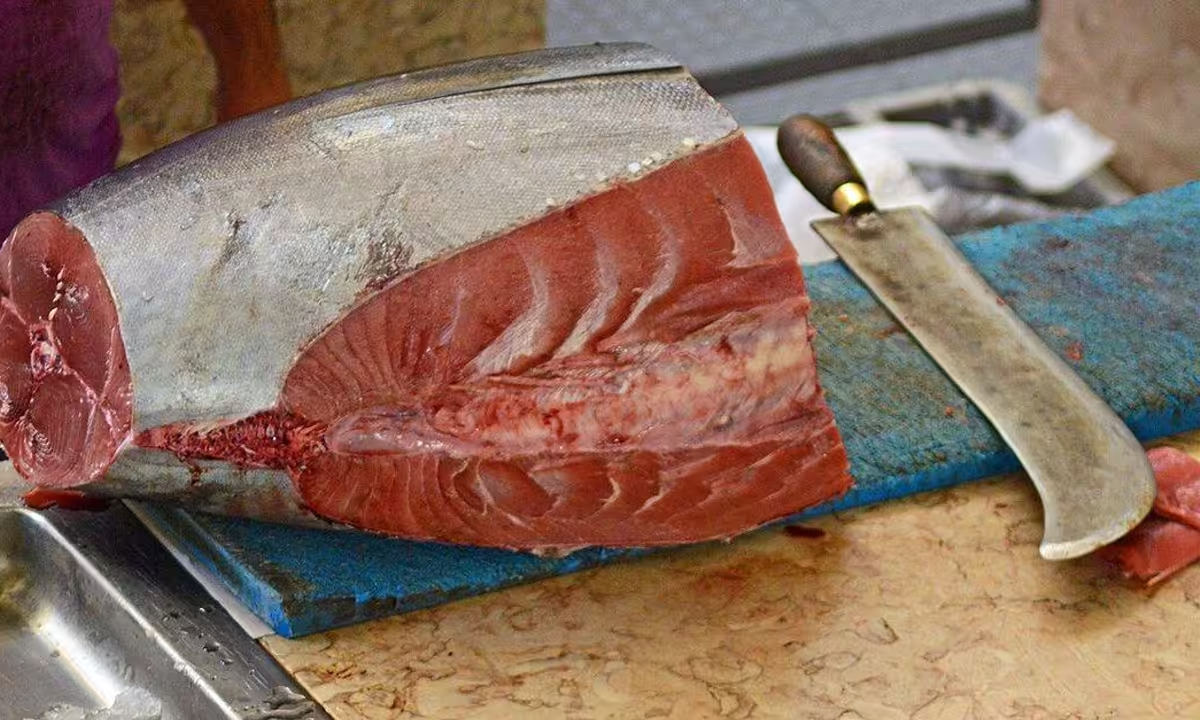
Wrap steaks individually in plastic, then foil or freezer bags with all the air pressed out. Vacuum sealing is the difference between good and great at the two-month mark.
Before it goes in
- Start with the freshest steaks you can find — deep red, never browned or slimy.
- Pat dry and wrap each steak tightly in plastic wrap.
- Overwrap in foil or slip into a freezer bag with the air pressed out.
- Label and freeze immediately; tuna's fat goes stale quicker than cod's.
Containers & wrapping
Plastic wrap against the flesh plus foil or a rigid freezer bag; vacuum-seal bags if you own the machine. Tuna oxidizes at any air pocket, so press everything out.
Freezer storage
2–3 months
The rich, almost steak-like flavor dulls with time; two months is peak. It stays safe while frozen solid — the calendar measures taste, not danger.
Cold does not make tuna (steaks) dangerous over time. Held at 0 °F / -18 °C it remains safe indefinitely, and the window above is an honest estimate of when texture starts to go.
Getting tuna (steaks) out of the freezer
Thaw in the refrigerator, still wrapped, about a day per inch of thickness. For searing, some cooks stop at half-thawed — the center stays rare while the surface takes the crust.
What happens if you refreeze tuna (steaks)?
Avoid it. Refrozen tuna weeps and toughens; if it thawed cold, cook it all and freeze cooked portions in dishes.
Texture & flavor changes
The dense, meaty texture survives better than most fish, but expect a little more purge and a slightly drier sear. The thawed surface deepens toward brown — oxidation, not spoilage.
Best uses after thawing
Where thawed tuna (steaks) shines:
- Seared steaks
- Poke bowls
- Grilled kebabs
- Niçoise salads
- Tuna burgers
Caveats worth knowing
- Much display-case tuna was previously frozen — refreezing it raw costs texture and buys you nothing.
- Thaw only in the refrigerator; tuna left on the counter is a genuine safety risk, not just a quality one.
- Browning or dull color before freezing means the fish is already fading — cook it fresh instead.
What people ask about freezing tuna (steaks)
Can you freeze fresh tuna steaks?
Yes — wrap each steak airtight in plastic and foil, or vacuum-seal, and freeze at 0 °F right away. Quality holds for 2–3 months. Because tuna is rich, it ages in the freezer faster than lean white fish, so pencil in the searing dates.
How long can you freeze ahi tuna?
Two to three months for best quality. Solidly frozen at 0 °F / -18 °C it stays safe indefinitely, but the clean, meaty sweetness that makes ahi special fades within a few months.
Can you refreeze tuna?
Not recommended. Thawed tuna releases moisture and toughens on a second freeze. If it thawed in the refrigerator and stayed cold, cook it all instead — then freeze the cooked tuna in salads or pasta dishes.
The details that decide it
A block of tuna is glazed, and the ice coating is doing the preserving
Frozen tuna is usually dipped so a layer of ice freezes onto the surface, and that layer, not the cabinet, is what holds the fish. Bigeye tuna blocks were stored at minus eighteen for six months with no glaze, a plain water glaze, and glazes carrying rosmarinic acid, sodium lactate, a bamboo-leaf antioxidant and a composite of the three. The unglazed block was worst on every measure and the composite glaze was best: its water-holding capacity after six months held near sixty-six per cent where the unglazed block had fallen to about fifty-one, its myofibrillar protein stayed highest, and its drip loss, total volatile basic nitrogen and malondialdehyde stayed lowest. The striking part is which variable governed cooking loss: across all six months that value tracked the glazing material rather than the storage time, so a good coat keeps behaving the same way while the calendar barely moves it. A water glaze was only a little better than nothing, because an ice layer with nothing dissolved in it blocks air without doing anything about oxidation, and the bamboo-leaf antioxidant that suppressed lipid oxidation best also stained the surface brown.
- A glaze, not the freezer alone, is what preserves a frozen tuna block.
- The best glaze kept water-holding capacity near sixty-six per cent after six months.
- Cooking loss tracked the glaze, while storage time barely moved it.
The temperature a tuna is stored at matters less than which part of the fish it is
Bluefin tuna is frozen in parts, and the parts do not behave alike. Storing the naked body, the middle belly and the big belly at minus eighteen and at minus fifty-five for six months showed water-holding capacity falling in all of them and faster at the warmer setting, with the lean naked body holding water best and the fatty belly worst. Redness fell sharply in the first weeks and then levelled, and the big belly was always the dullest because it carries more fat and less protein; the fat oxidises to free radicals that attack myoglobin and turn it brown. The belly also accumulated more malondialdehyde than the body throughout, and the colder store slowed that rise in both. Late in storage the salt-soluble protein of the two temperature groups converged, which is the honest limit of the cold: a colder freezer slows the chemistry, but the mechanical damage the crystals do to the muscle sets a floor that temperature cannot move.
- The lean body held water better than the fatty belly at either temperature.
- The fatty belly stayed dullest because its fat oxidises the myoglobin.
- By six months the two storage temperatures converged on protein loss.
Salting a tuna fillet before the freeze buys water and spends colour
A light salt pretreatment is a common way to protect frozen fish, and on yellowfin tuna fillets it works, with an asterisk. Fillets left untreated, salted statically, or salted with ultrasound assistance were frozen and compared, and the ultrasound-salted group came out ahead on almost everything measurable: higher water content, higher salt, a yield near one hundred and six per cent against about ninety-eight for the untreated fillets, better springiness and water-holding capacity, less cooking and thawing loss, and lower volatile basic nitrogen. Microscopy showed the salted muscle froze into smaller, more continuous crystals and thawed back into fuller, tidier fibres, which is the reason the water stayed. The cost is colour: the ultrasound-salted fillets lost redness, and proteomics over 781 proteins found myoglobin and the pigment-building enzyme coproporphyrinogen oxidase both down, so the pink faded by oxidation rather than by draining. Cavitation opens the filament lattice and lets myosin slide out of place, which is exactly what makes room for water and also what exposes the pigments.
- Ultrasound-assisted salting raised frozen tuna yield from about ninety-eight to one hundred and six per cent.
- Salted muscle froze into smaller, more continuous crystals and lost less on thawing.
- The gain came with a real loss of redness as myoglobin oxidised.
Related foods