Can You Freeze Mussels?
Mussels carry a secret the fish market confirms anyway: much of what is sold as fresh was previously frozen on the boat. Freezing them yourself closes that loop — scrub, shuck, and freeze in their own liquor, ready for a pot of white wine.
Also called: fresh mussels · black mussels · green-lipped mussels · shucked mussels
Yes — mussels freeze well for 2–3 months once scrubbed and shucked into their liquor; in-shell freezing works but is riskier.
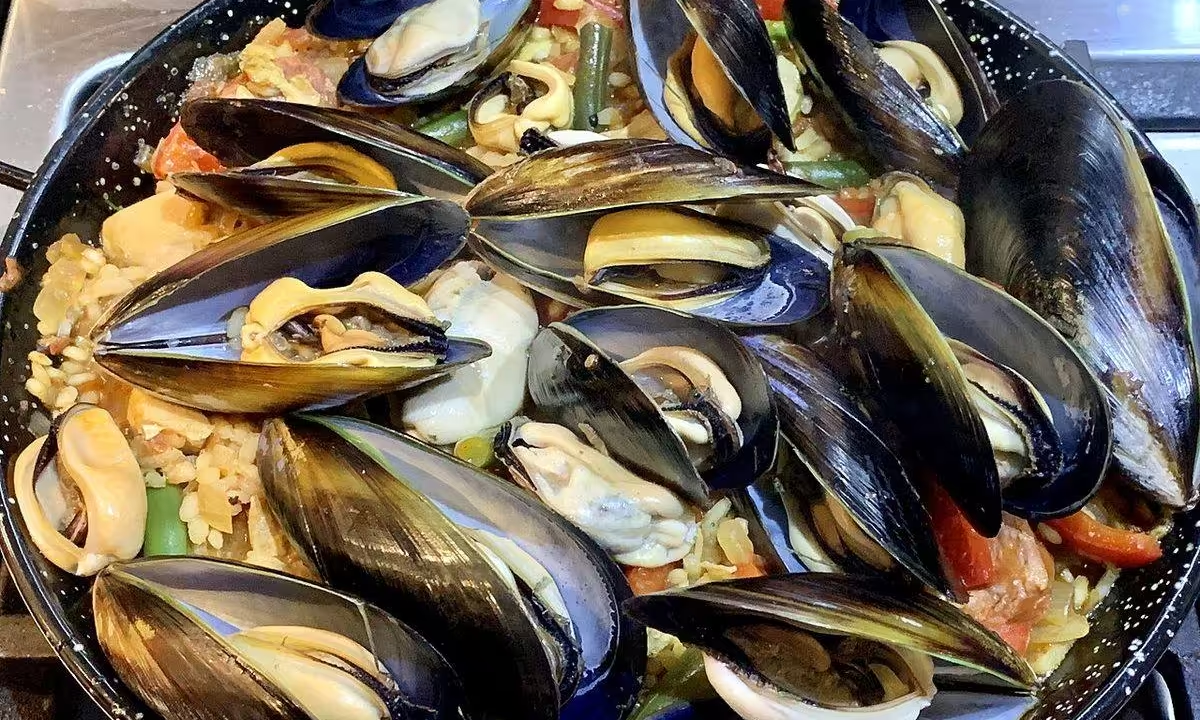
Freezing mussels: the method
Scrub and debeard, then shuck and freeze the meats in their liquor or on open trays before bagging. Mussels frozen in the shell can gape and leak; shucked meat is the reliable path.
Before it goes in
- Scrub the shells and pull off the beards while the mussels are still alive and closed.
- Discard any mussel that stays open when tapped — only sound ones freeze.
- Shuck raw, catching and reserving every drop of the liquor.
- Freeze the meats on a tray until solid, or pack them directly into their liquor.
- Bag airtight, label with the date, and freeze flat.
Containers & wrapping
Rigid containers with liquor for shucked meats; freezer bags pressed flat after tray-freezing. The liquor doubles as flavor insurance — never discard it.
Freezer storage
2–3 months
Quality is a texture story — thawed meats firm up less and weep more over time. Cook them thoroughly after thawing, as with all bivalves.
Safe and good are two different clocks for mussels: at 0 °F / -18 °C it stays safe as long as it is solidly frozen, and the 2–3 months window above is about eating quality.
How mussels should be thawed
Thaw overnight in the refrigerator in a bowl to catch the liquid. Cook straight away — mussels do not wait well, and thorough cooking is part of the plan.
Can you refreeze mussels once it has thawed at home?
No. Bivalves are marginal even on the first freeze; a second cycle is asking for rubber and risk.
Texture & flavor changes
Thawed mussel meats are softer and release liquor, so they belong in broths, pastas, and paellas rather than served on the half shell. The briny flavor holds up better than the bite.
Best uses after thawing
Where thawed mussels shines:
- Pasta
- Paella
- Chowders
- Brothy stews
- Seafood stock
Which version is it this time?
In-shell mussels freeze fastest but gape and lose liquor on thawing; shucked meats in their liquor freeze slower and behave better in the pan. Choose shucked unless freezer space is desperate.
Caveats worth knowing
- Only freeze live, tightly closed mussels — a gaping shell that will not close is already compromised.
- Commercial fresh mussels are often previously frozen; ask before buying and never refreeze those raw.
- Cook thawed mussels thoroughly — this is a food-safety step, not a suggestion.
Freezing mussels: your questions
Can you freeze fresh mussels?
Yes, with prep — scrub, debeard, discard any that stay open, then shuck and freeze the meats in their liquor or tray-freeze them loose. Quality holds for 2–3 months. Cook them thoroughly after thawing.
Can you freeze mussels in the shell?
Mussels tolerate in-shell freezing for 2–3 months, but shells often gape and drain liquor as they thaw. Shucked meats in their liquor keep noticeably better — the extra ten minutes of shucking pays for itself.
Can you refreeze mussels?
No — thawed mussels should be cooked and eaten within a day. Refreezing doubles the texture damage and thins the safety margin on a food that already demands careful handling.
The details that decide it
A frozen mussel fails on several separate meters at once, and they move together
It is tempting to score a frozen mussel on one number, but the research tracks several at the same time, and they move as a group. A study of Mytilus coruscus held at minus eighteen for ninety and a hundred and fifty days measured malondialdehyde for lipid oxidation, total volatile basic nitrogen for the breakdown of nitrogenous compounds, centrifugal loss for how much water the tissue can no longer hold, and texture, and describes the decay as the combined result of protein degradation, conversion of nucleotides and lipid oxidation running together. That coupling is the point for anyone storing shellfish: the smell marker, the water marker and the firmness marker are different readings of one process rather than independent faults. Watching a single meter will always understate how far a batch has gone.
- One study followed mussels at minus eighteen for ninety and a hundred and fifty days.
- Lipid oxidation, volatile nitrogen, water loss and texture were tracked together.
- The decay is protein degradation, nucleotide conversion and oxidation combined.
Two mussels of one species can freeze to different results, and sex is a factor
An unusual variable sits inside a bag of mussels that a bag of fillets does not have: the animals are not all the same, and their sex changes how they behave on ice. The same frozen-storage work reports that female and male Mytilus coruscus differ in their nutrient reserves, in metabolic regulation, in the conversion of the five-prime nucleotides that carry taste, and in the formation of lipid oxidation products during storage. In other words, the raw material arriving at the freezer is already chemically split, and the freezer widens the gap rather than closing it. For a cook the practical consequence is that a mixed bag can develop unevenly, and the texture or aroma noticed on the later-stored portion is not necessarily the whole batch changing at one rate.
- Female and male mussels differ in stored nutrient reserves.
- The sexes convert taste-carrying nucleotides at different rates.
- Lipid oxidation products form differently between the two sexes in storage.
Cooking a mussel before freezing changes what the freezer is working on
A mussel is often cooked before it is frozen, and that step rewrites the problem by denaturing the proteins in advance. Work on cooked mussel products pairs safety and quality in one assessment, exactly because a cooked, chilled shellfish is a different risk object from a raw one, and the general frozen-storage literature notes that cooking before freezing, together with protein denaturation during storage, changes how molecules cross-link and therefore how the product loses or gains weight. A cooked mussel is a set gel with the ice forming inside it, not a live tissue with a membrane to rupture. That is not automatically better or worse; it simply means the damage you measure afterward was seeded by the cook, and a short, hot treatment leaves the freezer less to do.
- Cooking before freezing denatures the proteins in advance.
- Cooked shellfish is assessed for safety and quality together.
- Cross-linking after cooking changes how a frozen product loses weight.
Related foods