Can You Freeze Ground Beef?
Ground beef is the freezer's first citizen — the family pack, the bulk buy, the Tuesday backup. Its only demand is technique: flatten it thin, portion it honestly, and the 3–4 month window will cover most of what a household actually eats.
Also called: minced beef · hamburger meat · ground hamburger
Yes — ground beef freezes well for 3–4 months; flatten it thin and portion it to match your recipes.
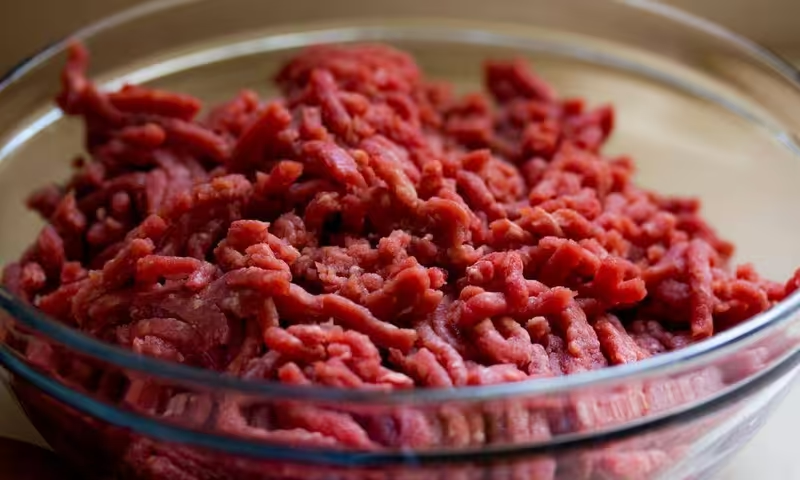
How to prepare and freeze ground beef
Portion into recipe-sized amounts, press each into a flat, even slab inside a freezer bag, and freeze. Thin slabs thaw in under an hour in cold water or brown straight from frozen.
Before it goes in
- Divide the beef into the portions your recipes actually use — half-pound for sauces, quarter-pound for patties.
- Press each portion flat inside a freezer bag, about half an inch thick.
- Squeeze out all the air and seal; flatten evenly so it thaws at one rate.
- Stack the packs vertically like files and label with weight and date.
Containers & wrapping
Freezer bags pressed flat are the everyday standard; vacuum sealing pushes quality toward the full four months. Rigid containers work but thaw slowly and hide the date — label them clearly.
Freezer storage
3–4 months
Ground beef keeps 3–4 months at best quality — shorter than whole cuts because grinding exposes more surface to air. It stays safe indefinitely at 0 °F / -18 °C; flavor is what fades.
Safe and good are two different clocks for ground beef: at 0 °F / -18 °C it stays safe as long as it is solidly frozen, and the 3–4 months window above is about eating quality.
The thawing rules for ground beef
Refrigerator-thaw overnight, or speed things up with sealed bags in cold water — flat slabs take 30–45 minutes. You can also brown it from frozen: start the block in a hot pan and chop it down as it softens.
Is a second freeze safe for ground beef at home?
Yes, if it thawed in the refrigerator and stayed cold — quality dips but it is safe to refreeze once. Meat that thawed on the counter should be cooked through first, then frozen as cooked crumbles.
Texture & flavor changes
Thawed ground beef browns and crumbles much like fresh, with a little more liquid in the pan. Pressed-flat slabs fare better than crumbly irregular chunks, because there is less surface for ice crystals to rough up.
Best uses after thawing
Where thawed ground beef shines:
- Tacos
- Bolognese and chili
- Burgers (pressed as patties first)
- Meatballs
- Casseroles
Which version is going in the freezer?
Freeze bulk as flat slabs for sauces and taco nights; freeze patties individually wrapped if burgers are the mission. Same 3–4 month window, very different thaw jobs.
Caveats worth knowing
- Freeze patties as patties — thawed loose hamburger pressed into shapes later binds poorly and crumbles on the grill.
- Gray color inside a frozen pack is normal (no air reaches it); browned, off-smelling thawed beef is not — discard without debate.
- Do not freeze beef already at its sell-by date; freezing stops the clock, it does not turn it back.
Ground Beef: freezer questions answered
How long can you freeze ground beef?
Three to four months for best quality. Ground beef stays safe indefinitely at 0 °F / -18 °C as long as it stays frozen, but grinding exposes more surface area to air, so flavor fades faster than in whole cuts. Vacuum-sealed packs hold quality longest.
Can you cook ground beef from frozen?
Yes — it is one of the few meats that pan-browns straight from frozen. Put the frozen block in a hot skillet, chop and flip it as the exterior browns, and it breaks into crumbles in 10–15 minutes. Drain the extra liquid and season as usual.
Can you refreeze thawed ground beef?
If it thawed in the refrigerator and stayed cold, yes — refreeze it once, accepting some quality loss. If it thawed in warm water or on the counter, cook it through completely and freeze the cooked crumbles instead. That keeps you safe and wastes nothing.
The details that decide it
Every extra cycle grinds the same mince again, this time at the scale of the crystals
A steak is frozen as one piece of tissue; mince is frozen as thousands, each already cut open, and each freeze-thaw cycle works on all of them at once. In a study that carried beef through five cycles, freezing at minus twenty degrees for twenty hours and thawing at room temperature for four, the authors describe the recurring crystals as causing mechanical damage, protein aggregation and a measurable rise in thaw loss, with flavour, texture and colour all degrading as the count went up. The point is that grinding changed the unit of damage. A whole roast resists the ice with intact fibres and fascia; mince has none, so the water that migrates out has an easy path to the surface, and once it leaves, it does not go back in on the next mild thaw.
- Mince is already cut open, so nothing shields it from the crystals.
- Five cycles measurably raised thaw loss and lowered texture scores.
- Water that reaches the surface in one thaw is not reabsorbed later.
The colour, the chew and the amino acids all fall to the same oxidation
What happens to ground beef beyond water loss is a single chemical event wearing several faces. Protein oxidation of beef myosin produces carbonyl groups and cross-linked dityrosine, and the number of dityrosine links tracks how far oxidation has gone. The downstream costs read like a list of complaints: dulled browning of the red pigment, meat that toughens under the fork, and a genuine depletion of essential amino acids, because oxidised side chains can no longer be released cleanly by digestion. None of it requires the freezer to be broken; it proceeds wherever oxygen, iron and a little unfrozen water meet, which is exactly the environment a bag of mince provides. Even a carefully iced tray still carries the machinery for this reaction in every crumb.
- Carbonyl groups and dityrosine cross-links mark advancing protein oxidation.
- Dityrosine levels correlate with the extent of oxidation.
- Oxidation dulls colour, toughens texture and reduces available amino acids.
Ground beef brings far more surface to the air than a steak ever does
The reason mince is more fragile than the cut it came from is geometric before it is chemical. Grinding multiplies the interface between meat and air, and reviews of frozen muscle name increased surface area and oxygen exposure as direct accelerants of lipid oxidation, alongside the micropores that form when surface ice slowly sublimes away and lets air reach deeper. On a solid steak only the outer rind meets that air; in a kilogram of mince the whole mass does. This is why the packaging choice matters more here than anywhere: excluding oxygen by vacuum or a tight flattened bag removes the co-reactant the reaction depends on, and it does more for a ground product than any temperature you could plausibly reach in a home freezer.
- Grinding multiplies the meat-to-air interface that oxygen attacks.
- Surface sublimation opens micropores that let air deeper into the pack.
- Removing oxygen by vacuum helps mince more than a colder setting would.
Related foods