Can You Freeze Steak?
Buying steaks in bulk only pays off if the freezer cooperates, and it does. A well-wrapped ribeye or strip comes back from 4–6 months of cold storage still worthy of a screaming-hot cast-iron pan — the entire trick is keeping air away from the meat.
Also called: ribeye · sirloin · filet mignon · new york strip
Yes — steak freezes well for 4–6 months when double-wrapped or vacuum-sealed; patted dry, it still sears properly.
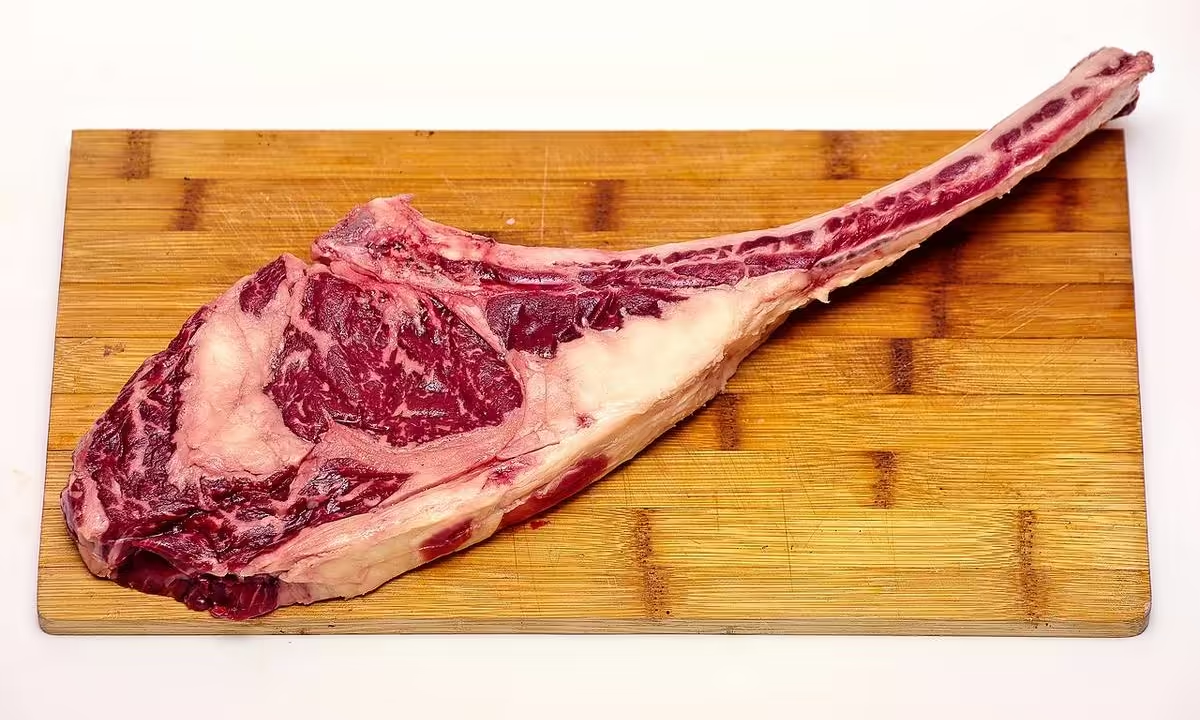
What to do before steak goes in the freezer
Vacuum-seal if you can; otherwise double-wrap — plastic wrap pressed against the meat, then heavy foil or freezer paper. Airtight wrapping is the whole difference between a great steak and a freezer-burned one.
Before it goes in
- Freeze steaks fresh, never after days lingering in the refrigerator.
- Press plastic wrap directly onto the meat surface, excluding all air.
- Add a second layer — foil, freezer paper, or a sealed freezer bag.
- Label with the cut, thickness, and date.
- Freeze flat and fast on the coldest shelf.
Containers & wrapping
Vacuum bags are the gold standard for steaks. Without one: tight plastic wrap plus foil or freezer paper, or a zip-top bag with every bubble pressed out. Butcher paper alone breathes — fine for a month, not six.
Freezer storage
4–6 months
Quality runs 4–6 months for steaks; big roasts tolerate 4–12. Solidly frozen beef stays safe indefinitely at 0 °F / -18 °C — the window protects your sear, not your health.
Treat the storage window on steak as a quality clock. Frozen solid at 0 °F / -18 °C it does not become unsafe with time; the window tells you when the eating starts to slip.
How to defrost steak
Thaw in the refrigerator overnight — a 1.5-inch steak takes 12–18 hours. Pat the surface bone-dry before salting and searing. Sealed bags can take a cold-water bath for faster thawing, but cook right away.
Can steak be thawed and refrozen?
Acceptable if fridge-thawed and still cold, though ice crystals will have roughed the surface — plan a marinade or a sauced preparation for the second freeze.
Texture & flavor changes
The crust sears up nearly the same; the interior runs a touch looser, releasing more juice into the pan. Resting the steak well after cooking recovers most of the difference. Expect fresh-tasting, not improved-tasting — freezing is neutral at best.
Best uses after thawing
Where thawed steak shines:
- Pan-seared steak
- Steak sandwiches
- Fajitas
- Beef stew (cubed)
- Steak salads
Which version are you freezing?
Thick steaks (1.5 inches and up) freeze and thaw with the least damage — less surface area relative to mass. Thin cuts dry faster; use them within 2–3 months.
Caveats worth knowing
- Freezer burn starts at the wrapper seams — a loose fold of foil is where quality goes to die; wrap with intent.
- Do not thaw steaks in hot water or on the counter; the exterior warms into the danger zone long before the center gives.
- Marinate after thawing, not before freezing — thawed meat drinks marinade best once it is fully defrosted.
Questions about freezing steak
How long can you freeze steak?
Four to six months at best quality, with vacuum-sealed steaks lasting the full span. Beef stays safe indefinitely while frozen solid at 0 °F / -18 °C, but unsealed steaks pick up freezer burn within weeks, which shows up as gray, papery patches after thawing.
Does freezing steak ruin it?
No — not if it is wrapped airtight. Freezing forms ice crystals that slightly loosen the muscle fibers, so a thawed steak releases a bit more juice, but a hot sear and a proper rest close the gap. Air exposure, not freezing itself, is what ruins steaks.
How do you thaw steak so it keeps its texture?
Overnight in the refrigerator, still in its paper until it is cold — a fast counter thaw bleeds moisture through the whole cut.
The details that decide it
Sound in the brine breaks the crystals a slow freeze would leave in a steak
Air freezing is slow, and slow freezing builds the large crystals that tear a steak apart, so the useful question is what you can put in the freezer to interrupt them. Beef was frozen in still air, by plain immersion, and by immersion with ultrasound at two hundred, four hundred and six hundred watts, then compared for water-holding capacity, tenderness, colour, oxidation and myofibrillar protein function. Four hundred watts was the setting that worked: its carbonyl, sulfhydryl and thiobarbituric acid reactive substances values were statistically indistinguishable from never-frozen beef, and its water-holding capacity, tenderness and colour sat closest to the fresh control, with the protein structure and function preserved. The mechanism is mechanical as much as thermal, because the microjets that cavitation throws off shatter the big crystals into fine uniform ones and shorten the window in which crystals can grow. The two other powers are the useful warning: two hundred watts was too weak to cavitate usefully, and six hundred watts cavitated so hard it damaged the meat, so this is a window rather than a dial to turn up.
- A slow air freeze grows the large crystals that tear a steak.
- Four hundred watts of ultrasound left oxidation markers and tenderness near fresh.
- Two hundred watts was too weak and six hundred too damaging.
A steak keeps best just under zero, before the ice becomes the problem
Between the fridge and the freezer there is a band where a steak stays firm and unfrozen, and the right end of that band may be the best place to keep it. Beef was stored superchilled at minus one point eight and minus two point eight, mild-frozen at minus four and minus five, and chilled at two and six degrees, and followed for colour, texture, oxidation, volatile basic nitrogen, drip loss and pH. The superchilled samples held their quality longest: their colour, texture, oxidation and drip measures all drifted more slowly, and they stayed firm throughout, while the colder mild-frozen samples actually picked up more structural damage and lost firmness from the ice that formed in them. The chilled samples were the worst, and by the end both the two and six degree groups had pushed past the volatile basic nitrogen spoilage threshold of fifteen milligrams per hundred grams, with the lowest firmness of any group. The conclusion is a compromise rather than a winner, because the superchilled band preserves quality, cuts the energy a freezer needs and keeps the steak sliceable.
- Superchilling just under zero held colour, texture and water better than deeper freezing.
- Mild freezing below that caused more structural damage and lost firmness.
- Chilled samples passed the spoilage threshold before the superchilled ones moved.
Two months frozen and one week chilled are two different kinds of loss
A steak kept frozen and a steak kept cold fail in different ways, and beef bottom round was run through both to show it. One set was stored at minus eighteen for two months and another at four degrees for a single week, and both were checked for colour, pH, water-holding capacity, texture, lipid oxidation and volatile flavour compounds. Both storage routes hurt the surface colour and the pH, which the authors tie to what a shopper decides on, and the frozen route specifically reduced water-holding capacity and texture and raised lipid oxidation, because freezing and thawing opens the muscle to its own drip. The refrigerated route instead showed its damage in the volatile compounds, which is to say in flavour, as the profile shifted over just one week. For a cook the split matters: the freezer buys time and charges water and texture, while the fridge buys almost none and charges flavour.
- Frozen storage cost the steak water-holding capacity, texture and oxidative stability.
- Refrigerated storage changed the volatile flavour profile within a week.
- Both routes dulled the surface colour that shoppers judge by.
Related foods