Can You Freeze Egg Yolks?
Yolks are the temperamental half of the egg. Untreated in the freezer they turn pasty and rubbery, refusing to blend into anything silky. A spoonful of salt or sugar prevents that — pick by whether the recipe runs sweet or savory.
Also called: egg yolk · frozen yolks · yolks
Yes — yolks freeze if you first whisk in a little salt or sugar, which keeps them from turning gummy.
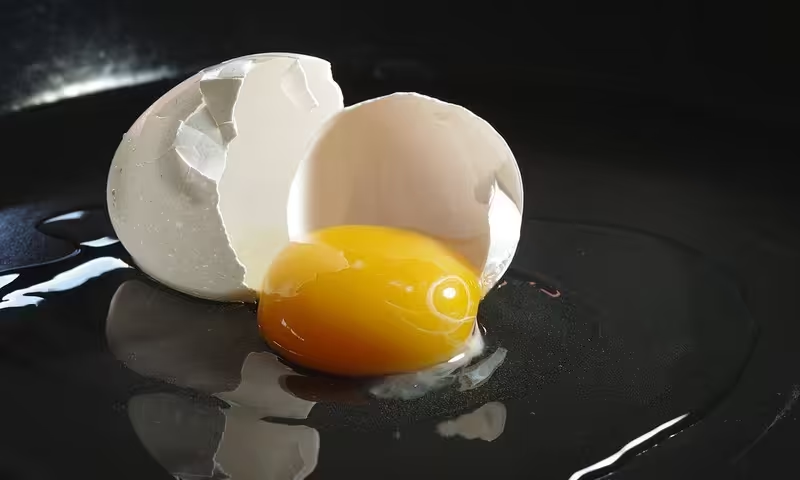
Freezing egg yolks the right way
Whisk the yolks with either 1/8 teaspoon of salt or 1.5 teaspoons of sugar or corn syrup per quarter cup (about four yolks), then freeze in small labeled portions.
Before it goes in
- Whisk the yolks until completely smooth and uniform in color.
- Add 1/8 teaspoon of salt per quarter cup for savory use, or 1.5 teaspoons of sugar for sweet.
- Pour into an ice-cube tray or small containers in recipe-sized portions.
- Freeze solid, bag, and label loud and clear: salted or sweetened.
Containers & wrapping
Ice-cube trays then bags, or small rigid containers. Treated yolks freeze dense and pop out cleanly; untreated ones cling — one more reason to treat them.
Freezer storage
up to 12 months
The salt or sugar addition protects texture but not indefinitely; treated yolks are best within a few months for custard-grade work.
Read the window on egg yolks as advice, not a warning. At 0 °F / -18 °C it is safe to eat at any age; up to 12 months is simply where the flavor and texture are worth the most.
Thawing egg yolks: what to do
Refrigerator-thaw overnight, then stir well — treated yolks stay pourable. Remember the added salt or sugar when you season the final recipe.
Can thawed egg yolks be frozen again at home?
Not recommended. Untreated yolks gel worse each cycle and treated ones slowly turn grainy; portion once, correctly.
Texture & flavor changes
Untreated yolks freeze into a gummy, almost plastic mass that never fully reincorporates. Treated yolks stay workable, a shade thicker than fresh — in custards, curds, and carbonara the difference vanishes.
Best uses after thawing
Where thawed egg yolks shines:
- Custards and ice cream bases
- Lemon curd
- Carbonara-style sauces
- Crème brûlée
- Brioche and enriched doughs
Caveats worth knowing
- Label treated yolks salty or sweet in capital letters — the wrong batch ruins whatever dish it lands in.
- The seasoning is real: count the added salt toward the recipe or the curd comes out over-salted.
- Once yolks have gelled from freezing bare, nothing reliably reverses it; use them mashed into fillings instead.
What readers ask about egg yolks
Why do frozen egg yolks turn gelatinous?
Yolk proteins and lipids knit into a gel as ice crystals disrupt their structure — it is chemistry, not spoilage. Whisking in a pinch of salt or a teaspoon of sugar per few yolks interrupts the gel and keeps them pourable.
Can you freeze leftover egg yolks without adding anything?
You can, but they will gel into a pasty lump that resists blending. If that has already happened, grate or mash the thawed yolk into deviled-egg filling or a sandwich spread rather than forcing it back into a custard.
How long can you freeze egg yolks?
Up to twelve months while frozen solid, with quality best in the first few months. The salt or sugar that prevents gelling also keeps flavor steadier, but custard-bound yolks deserve earlier use.
The details that decide it
Six saccharides limited the ice in a frozen yolk, and two of them kept it viscous instead of gelled
The classic complaint about frozen egg yolk is that it sets like putty as it thaws, and the usual industrial answer is sugar or salt stirred in before freezing. This study compared six saccharides on the same yolk base at a minus eighteen storage temperature: sucrose, trehalose, L-arabinose, xylitol, D-cellobiose and a xylooligosaccharide preparation. Measured by calorimetry, the saccharides shortened the freezing time and lowered the enthalpy and the apparent specific heat of the yolk, which the authors read as less ice forming in the first place, and the size of the effect tracked the molecular weight of the additive. The rheology separated the six. L-arabinose and xylitol were the two that preserved the viscous behaviour of the thawed yolk rather than letting it turn elastic, which the authors attribute to controlled protein aggregation. The best of the treatments also pulled the measured freezing time down to forty-nine minutes from the untreated sixty-nine, a fall of forty-eight per cent.
- The yolk samples were stored frozen at minus eighteen.
- Six saccharides were compared: sucrose, trehalose, L-arabinose, xylitol, D-cellobiose and a xylooligosaccharide.
- The best treatment cut the measured freezing time from about sixty-nine minutes to forty-nine.
An exopeptidase at three-tenths of a per cent kept a thawed yolk behaving like a fresh one
If the gel comes from proteins unfolding and sticking together, an enzyme that trims the protein surface should be able to stop it, and this study tested exactly that on yolk put through a freeze-thaw cycle. The preparation used had exopeptidase activity and was applied at a series of concentrations, with the rheological behaviour of the thawed yolk compared against a fresh untreated control. The three-tenths of one per cent level was the most effective at preserving the rheology, and the treated samples ended up with a significantly lower yield stress and consistency coefficient than the untreated frozen yolk, which is the mechanical signature of a gel network that never formed. The same dose also produced the lowest pH values recorded in the trial, which the authors link to the enzyme releasing free amino acids into the mixture as it works on the protein termini.
- The most effective enzyme dose was zero point three zero per cent by weight.
- Treated samples had significantly lower yield stress and consistency coefficient than untreated frozen yolk.
- The same dose produced the lowest pH values measured in the trial.
Adding lipoprotein made a thawed yolk set harder, and the HDL fraction did more of it
Egg yolk is not one protein but a suspension of two lipoprotein assemblies, and this study asked which of them drives the gelling when the yolk freezes. The starting liquid contained ten per cent low-density lipoprotein and two point five per cent high-density lipoprotein, and the authors raised each of those separately by three, six and nine per cent before freezing the samples and thawing them. Gelation intensified as either fraction rose, and the high-density fraction was the more powerful of the two. The clearest demonstration came at the middle dose: with plus six per cent low-density lipoprotein the thawed liquid partly flowed down the tube, while the same increase in high-density lipoprotein left the yolk fixed where it stood. The water moved with it, with bound water rising and the fixed free water falling as the lipoproteins went up.
- The untreated yolk contained ten per cent LDL and two point five per cent HDL.
- Lipoprotein was added at three, six and nine per cent above those levels.
- At plus six per cent the LDL sample partly flowed while the HDL sample stayed fixed.
Related foods