Can You Freeze Yogurt?
Yogurt freezes the way it looks: honestly. The texture that made it creamy never survives, but the tang does — and tang is the useful part in marinades, dressings, and baking. Freeze it in the amounts your recipes actually use.
Also called: plain yogurt · regular yogurt · yoghurt
Yes — yogurt freezes safely, but thawed it turns grainy and watery, making it far better stirred into cooking than spooned fresh.
How to pack and freeze yogurt
Portion into ice-cube trays or small freezer containers, stirring first. Sweetened or fruit-on-the-bottom styles freeze no better, so plain yogurt in usable amounts is the move.
Before it goes in
- Stir the yogurt until smooth and uniform.
- Spoon into ice-cube trays (about 2 tablespoons per cube) or half-cup containers.
- For marinade portions, freeze in flat bags labeled with the amount.
- Leave headroom in rigid containers — about half an inch.
Containers & wrapping
Ice-cube trays then freezer bags for cubes; small glass or rigid freezer containers with headroom for bigger portions. Yogurt tubes can go in as-is.
Freezer storage
1–2 months
The live cultures largely go dormant — thawed yogurt is not a probiotic showcase. The earlier it is used, the brighter it tastes.
Cold does not make yogurt dangerous over time. Held at 0 °F / -18 °C it remains safe indefinitely, and the window above is an honest estimate of when texture starts to go.
The thawing rules for yogurt
Refrigerator-thaw for several hours or overnight, then stir hard. Cubes thaw in under an hour and can go straight into smoothie blenders or warm (not boiling) sauces.
How many times can you freeze yogurt?
Not recommended — graininess compounds and the whey weeps worse each time. Freeze in single-use portions instead.
Texture & flavor changes
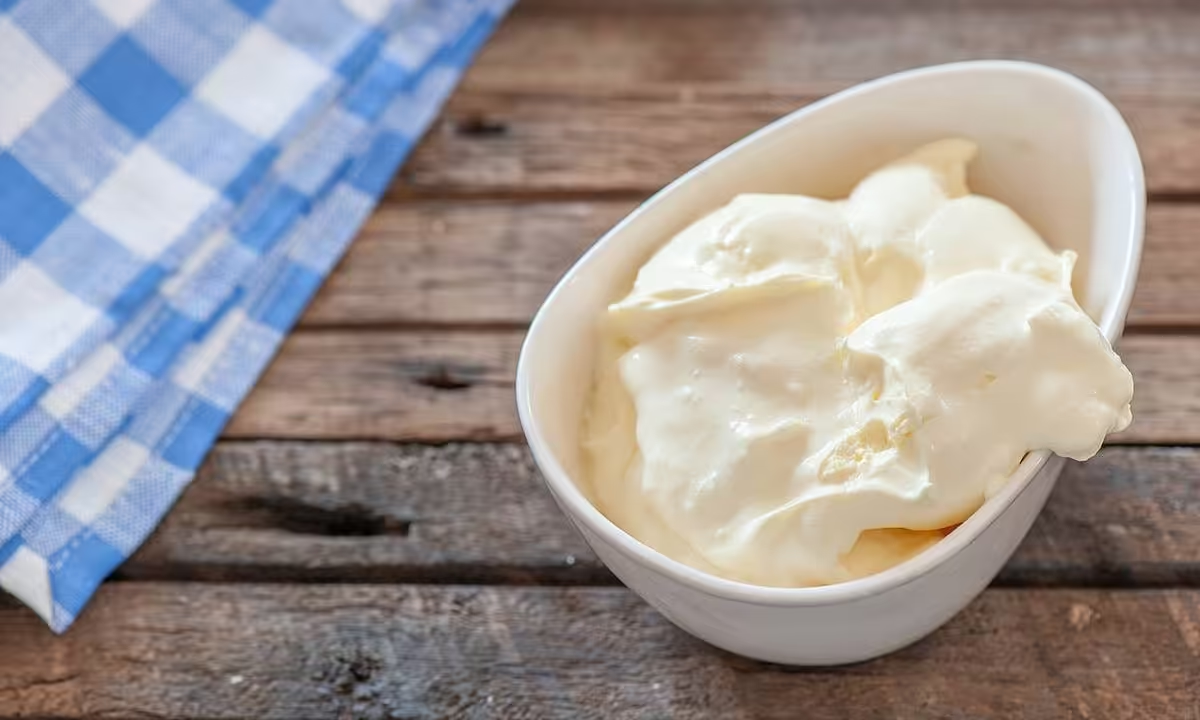
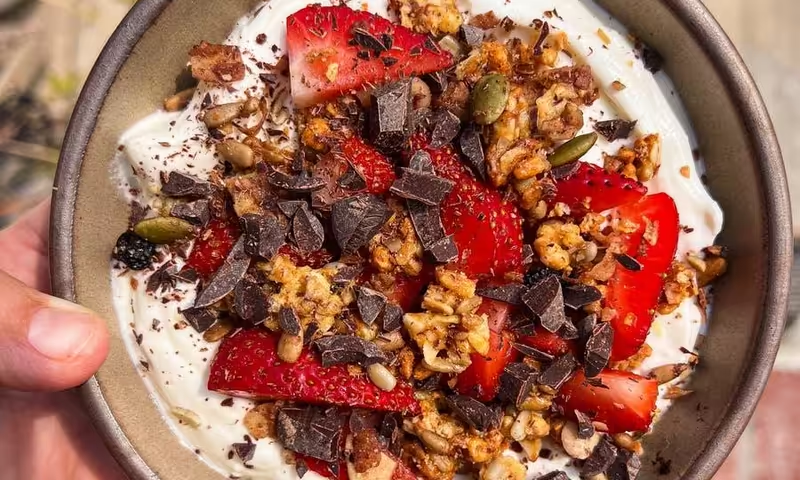
Expect visible whey pooling and a curdled, slightly chalky texture once stirred. In smoothies, marinades, and batters the change vanishes; on a spoon with granola, it never quite recovers.
Best uses after thawing
Where thawed yogurt shines:
- Smoothies
- Marinades
- Raitas and sauces
- Baking
- Frozen yogurt bark (freeze once)
Which version is it this time?
Plain yogurt freezes more predictably; fruit-on-the-bottom styles weep extra syrup after thawing. Greek yogurt holds up a little better than regular because it starts with less water — see its own card.
Caveats worth knowing
- Do not expect the same spoonable creaminess after thawing — plan dishes that hide texture, not showcase it.
- Yogurt in glass jars needs an inch of headroom and freezer-rated glass, or the expansion cracks the jar.
Yogurt: questions about the freezer
Can you freeze yogurt cups to eat later as yogurt?
You can freeze the cups, but thawed yogurt is grainy and watery rather than creamy, so it rarely satisfies eaten straight. It shines in smoothies, baking, and marinades where texture does not matter.
How long can you freeze yogurt?
One to two months for best quality and flavor. It stays safe indefinitely while frozen solid, but the texture separation deepens the longer it sits.
Does frozen yogurt still have live cultures?
Most cultures survive freezing in reduced numbers and go dormant. Thawed yogurt still carries some, but treating it as a probiotic food is stretching it — the texture change is the bigger fact anyway.
The details that decide it
Bifidobacteria held a frozen yogurt near two hours of melt while the plain starter mix ran past four
A frozen yogurt is a foam plus a gel, so bacteria, air and melt behaviour all move together in the freezer, and this trial made five blends to separate them. Each mix was standardized to eight per cent fat, twelve per cent milk solids, sixteen per cent sugar and a stabilizer, then inoculated with a starter culture alone or with Bifidobacterium adolescentis and Bifidobacterium infantis at one per cent each, incubated at thirty-seven degrees to a pH of 5.9, frozen in a batch freezer and hardened at minus eighteen for twenty-four hours. Storage then ran sixty days at minus eighteen, with analyses on days zero, fifteen, thirty and sixty. The plate counts fell with time, most steeply in the blend carrying the adolescentis strain, which lost seventy-one per cent of its population. The rheology moved the other way: the plain mix hardened from seventy-five to eighty-five grams and its meltdown time stretched from a hundred and sixteen to two hundred and sixty-five minutes, while the mixes carrying bifidobacteria stayed near two hours and roughly ninety-eight grams. Overrun nearly doubled when the bifidobacteria went in, from under twenty-five per cent to about forty-three.
- Five blends ran sixty days at minus eighteen, sampled on days zero, fifteen, thirty and sixty.
- The adolescentis blend lost seventy-one per cent of its population across the storage.
- The plain mix hardened from seventy-five to eighty-five grams and melted over two hundred and sixty-five minutes instead of a hundred and sixteen.
A berry powder made a frozen cup read as less icy and more coating, and the panel still took it
Freezing usually costs a yogurt its smoothness, so this study asked whether a fruit powder could buy some back while keeping the product acceptable. The plain yogurt was Greek style, made from low-fat milk with skim milk powder, heated to eighty-five degrees for five minutes, cultured at forty-two and incubated about five hours to a pH of 4.6; the fortified version was fifty-two per cent of that yogurt, sixteen per cent Saskatoon berry powder and thirty-two per cent water, with no added sugar. Portions of fifty grams went into hundred-and-four millilitre cups and froze at minus twenty-eight, and before each tasting the cups moved to minus fifteen about eighteen hours ahead and were served at minus three. On a fifteen-centimetre descriptive scale the fortified cup scored higher for berry aroma, berry flavour, sweetness, viscosity and mouth coating, and lower for cream aroma, sourness and iciness, which is the texture the freezer usually ruins. The powder carried about ten times the antioxidant capacity of the yogurt without losing it to the matrix, and consumer panels still rated the fortified cup lower for aroma and texture even though flavour, colour and overall acceptability did not differ.
- The fortified mix was fifty-two per cent yogurt, sixteen per cent berry powder and thirty-two per cent water.
- Fifty-gram portions froze at minus twenty-eight in hundred-and-four millilitre cups and were served at minus three.
- The powder carried about ten times the antioxidant capacity of the plain yogurt.
Two days at minus forty still softened the yogurt, and a three per cent complex did not stop it
Antifreeze molecules are usually tested in a model system, which is kinder than a real tub, and this study moved the test into the dairy. Whey protein isolate and soy protein isolate were complexed with locust bean gum and lambda carrageenan at five to one by dry matter through pH cycling, and the hydrolysed versions were made too. The complexes went into the yogurt at three per cent as-is, which the authors put at eighteen to nineteen and a half per cent of the dry matter, far above a normal additive level. Samples were frozen two days at minus forty and two more at minus twenty-two, thawed overnight at four degrees and equilibrated two to three hours, then probed with a two-and-a-half-centimetre cylinder at one and a half millimetres per second to a depth of fifteen millimetres. Firmness, cohesiveness and consistency fell under every treatment, exactly as they fell in the untreated controls. Only the hydrolysed whey and carrageenan complex held the macroscopic texture, and lacunarity imaging of the microstructure still showed elevated graininess, so the work stands as a proof of concept rather than a solution.
- The yogurt spent two days at minus forty and two more at minus twenty-two before thawing overnight at four.
- The complexes went in at three per cent as-is, eighteen to nineteen and a half per cent of the dry matter.
- Only the hydrolysed whey and carrageenan complex held the texture, and the imaging test still failed it.
Related foods