Can You Freeze Wine?
The last glass of a bottle is rarely enough for anything, which is exactly why cooking wine belongs in cubes. Frozen wine never quite returns as a sipping pour — the delicate aromatics dull in the cold — but in a pan sauce, a braise, or a risotto, nobody can tell.
Also called: red wine · white wine · cooking wine · leftover wine
Yes — wine freezes well in cooking portions; for drinking it loses aromatics, so cube leftovers for the saucepan.
How to freeze wine properly
Freeze wine in ice-cube trays in two-tablespoon portions for sauces, or in half-cup bags for braises and stews. Cooking cubes go straight from freezer to hot pan; there is no thawing ceremony required.
Before it goes in
- Decide honestly: wine for the glass does not survive freezing well — plan cubes for cooking.
- Pour into ice-cube trays, roughly two tablespoons per cube.
- For braise-sized portions, measure half-cups into flat freezer bags.
- Freeze solid, then bag the cubes so they do not pick up freezer smells.
Containers & wrapping
Ice-cube trays plus bags for cooking portions; flat freezer bags for half-cups. Never freeze a sealed full bottle — expanding wine pushes corks out and cracks glass.
Freezer storage
3 months
Cooking quality holds the full window; drinking quality fades within weeks. It stays safe while frozen — wine's own acidity and alcohol help keep it that way.
Keep the freezer at 0 °F / -18 °C and safety stops being a question for wine. What the calendar measures is quality: past its window it is safe, only a step further from fresh.
Thawing wine the right way
For cooking, skip it — cubes melt in the hot pan in a minute or two. For drinking, thaw in the refrigerator and expect a flatter, duller glass; it is better spent in the saucepan.
Can wine be thawed and refrozen without risk?
Fine for cooking portions. Wine is forgiving; the cube melts, the alcohol and acid do their job, and a second freeze costs nothing that matters.
Texture & flavor changes
The aromatics that make wine worth drinking dull and fade in the freezer, so a thawed glass reads flat and one-dimensional. In cooking, the acidity, tannin, and fruit all survive — which is precisely why the cube is the right home for leftovers.
Best uses after thawing
Where thawed wine shines:
- Pan sauces
- Braises and stews
- Risotto
- Marinades
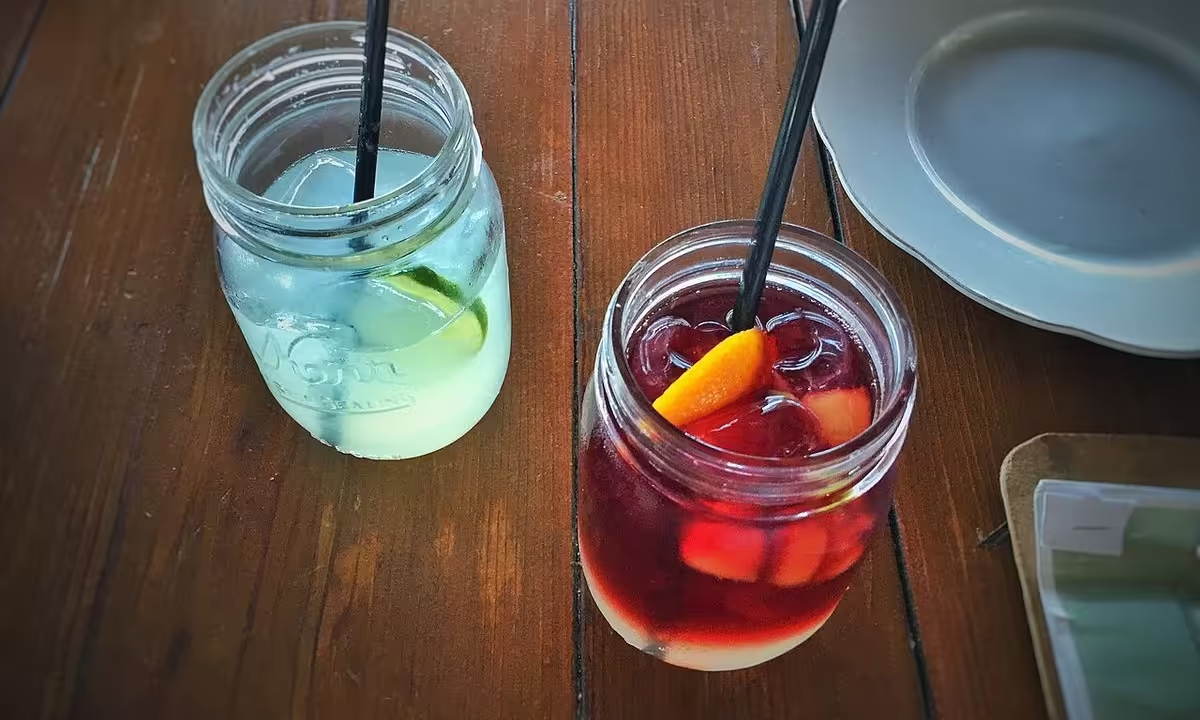
- Sangria bases
Which version is it this time?
Both freeze well. Red cubes suit braises, stews, and tomato sauces; white cubes suit cream sauces, seafood pans, and risotto. Label the bags — frozen red and white cubes look identical.
Still wine is the straightforward case. Sparkling wine freezes too, but its defining trait — the bubbles — is gone for good, so it lands squarely in the cooking-cube camp rather than the glass.
Caveats worth knowing
- Never freeze a sealed or full bottle — expansion pushes corks and shatters glass, and the freezer smells like the aftermath for weeks.
- Wine above roughly 15 percent alcohol will not freeze solid; it turns slushy, which is fine for cooking but never glass-clear.
- Sparkling wine has already lost its point before the freeze — the fizz dies either way, so send it to the cubes too.
Wine: questions about the freezer
Can you freeze wine for cooking?
Yes, and it is the best use of leftover wine. Freeze it in two-tablespoon cubes for sauces or half-cup portions for braises, and drop the frozen pieces straight into the hot pan. The cooking qualities survive perfectly.
Does freezing wine ruin it?
For drinking, mostly — the delicate aromatics dull and the glass tastes flat. For cooking, no; the acidity, tannin, and fruit that matter in a pan all hold up. Freeze it in portions matched to how you cook with it.
How long can you freeze wine?
About three months for cooking quality. It stays safe while frozen solid, and the acidity keeps it stable, but flavor dulls gradually — label the date and rotate the oldest cubes into the next sauce.
The details that decide it
A month at minus twenty lowered the sugar, acid and tannin of a finished ice wine
Wine is mostly water but the alcohol and sugar keep it from freezing to stone, so a bottle left in the freezer becomes a slush with a liquid core. This study pasteurized Beibinghong ice wine and then held one set at minus twenty for a month against a sixteen-degree control, measuring the basic chemistry afterwards. Total sugar across every sample ran from 201.09 to 324.60 grams per litre, and the frozen groups came in lower than the control, which the authors read as a softer and creamier balance rather than a loss. Total acidity fell by 27.90 per cent in the nine-per-cent group, 30.54 per cent in the ten- and 18.55 per cent in the eleven-, so the freezing blunted the tart edge. Anthocyanins were highest in the frozen eleven-per-cent wine at 42.75 milligrams per litre while the control ten-per-cent held 59.89, the lowest tannin fell to 1.75 grams per litre, and the pH barely moved at all.
- The frozen wine sat at minus twenty for one month against a sixteen-degree control.
- Total sugar ran from 201.09 to 324.60 grams per litre across the samples.
- Total acidity fell 27.90, 30.54 and 18.55 per cent in the three frozen groups.
Grapes frozen whole for six days fermented into a darker, more acidic wine
Freezing the fruit before the crush is the pre-fermentation version of the same idea, and wineries use it to concentrate solutes and shift the phenolics. Here Cabernet Sauvignon grapes were split across three storage temperatures, room at twenty degrees, chilled at four, and frozen at minus twenty, and held for two, four and six days before each lot was fermented and analysed. Soluble solids in the finished wines ranged from 31.96 to 38.82 grams per litre, the highest sitting in the grapes frozen for two days and the lowest in those chilled for four. Titratable acidity ran 11.59 to 13.64 grams per litre, with the frozen group highest and no treated wine dipping below the control, as acidity generally fell the longer the fruit was held. Colour split too: the frozen six-day wine carried the lowest lightness, and the wines together spanned a colour saturation from 31.38 to 46.24.
- Grapes were held at twenty, four and minus twenty degrees for two, four and six days.
- Soluble solids reached from 31.96 to 38.82 grams per litre.
- Titratable acidity ran 11.59 to 13.64 grams per litre, highest in the frozen group.
Frozen juice for ice wine fermented slower the sweeter the thawed must became
Ice wine is the commercial case for freezing a beverage on purpose: the grapes freeze on the vine, much of the water stays behind as ice, and the pressed juice arrives already concentrated. This study began from frozen Vidal grape juice held at minus twenty, thawed it and clarified it for a day at four degrees with 0.8 grams per litre of bentonite, then set the initial sugar across four batches at 370, 450, 500 and 550 grams per litre, adjusting the glucose-to-fructose ratio with each level. Every batch received 350 milligrams per litre of yeast-assimilable nitrogen and fermented at seventeen to nineteen degrees for fifty days before stabilization. Ethanol peaked at 130.26 grams per litre in the lowest-sugar batch, then 121.77, 106.14 and 90.85 as the sugar climbed, so the more concentrated the frozen juice, the slower and weaker the fermentation ran.
- The Vidal juice was stored frozen at minus twenty, then thawed and clarified for a day.
- Initial sugar was set at 370, 450, 500 and 550 grams per litre across four batches.
- Fermentation ran fifty days at seventeen to nineteen degrees with 350 milligrams of nitrogen.
Related foods