Can You Freeze Meatballs?
Meatballs may be the single most freezer-friendly cooked food there is — portioned protein, built-in fat, and a shape that reheats evenly. Cook a double batch, freeze half in sauce or plain, and you have tonight's spaghetti and next month's soup from one mess.
Also called: cooked meatballs · frozen meatballs · swedish meatballs · homemade meatballs
Yes — meatballs are a freezer classic: cooked they hold 2–3 months and reheat into dinner almost as made.
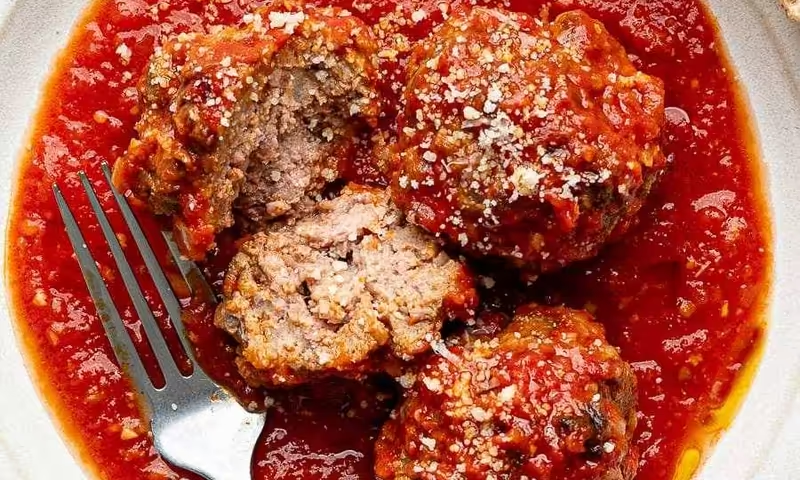
Freezing meatballs the right way
Cook or par-cook the meatballs, cool them completely, then freeze on a tray until solid before bagging. Tray-freezing keeps them round and separate, so you can pour out six instead of thawing a clump.
Before it goes in
- Cook the meatballs through, or brown them well if finishing in sauce later.
- Cool completely — warm meatballs steam the bag and invite ice.
- Freeze on a lined tray until solid, about an hour.
- Bag in meal portions, pressing out air, and label with the date.
Containers & wrapping
Freezer bags for plain meatballs; rigid containers for sauced ones, with headroom. A spoonful of sauce or broth in plain bags guards against dry edges.
Freezer storage
2–3 months
Cooked meat dishes hold quality 2–3 months; sauced meatballs taste best early, while the sauce is still bright. Safe indefinitely while frozen solid at 0 °F / -18 °C.
Freezer burn, drying and dulled flavor are quality problems with meatballs, not safety ones — anything solidly frozen at 0 °F / -18 °C is still fine to eat, just further from fresh.
The safest way to thaw meatballs
Refrigerator-thaw overnight, or drop frozen meatballs straight into simmering sauce or soup — 15–20 minutes reheats them through. That straight-to-sauce move is the weeknight magic of this card.
Can meatballs be thawed and refrozen without risk?
Only if they thawed in the refrigerator and were never reheated — and honestly, the quality is better spent. Freeze in meal portions from the start.
Texture & flavor changes
Barely any: the breadcrumb-and-egg structure resists ice damage, and sauce masks whatever softening occurs. Unsauced meatballs dry slightly at the surface; a simmer in sauce restores them fully.
Best uses after thawing
Where thawed meatballs shines:
- Spaghetti and marinara
- Swedish meatballs
- Meatball subs
- Soups
- Appetizers with sauce
Which version do you have?
Raw-formed meatballs freeze well too — freeze on trays, bag, and cook from frozen with a few extra minutes. Cooked-and-cooled is the more flexible option, since they reheat straight into sauce.
Caveats worth knowing
- Cool the meatballs fully before bagging — trapped steam is what turns good batches icy and stale-tasting.
- Very lean meatballs (all breast meat, minimal fat) dry fastest; a little fat or sauce in the pack protects them.
Meatballs: freezer questions answered
Can you freeze cooked meatballs?
Yes — it is one of the best moves in home freezing. Cool them completely, freeze on a tray until solid, then bag in meal portions for 2–3 months. Reheat from frozen straight in simmering sauce, or thaw overnight in the refrigerator.
Can you freeze meatballs with sauce?
Yes — sauced meatballs freeze beautifully for 2–3 months in rigid containers with headroom. The sauce protects against drying, and the whole dish reheats together. Plain-frozen meatballs stay more flexible for soups, subs, and different sauces later.
Can you freeze raw meatballs?
Yes — freeze them raw on a tray first so they stay separate, then bag them and cook straight from frozen for the best texture.
The details that decide it
A meatball loses its water at the surface first, so the coating is the fix
A meatball loses its water at the surface first, so the coating matters as much as the meat. Work on a starch coating reinforced with carbon dots followed both the coating and the meatballs through repeated freeze-thaw cycles, and the two failed together: the starch gel expelled water, its ordered structure and crystallinity rose as it retrograded, and the meatballs inside lost thawing and cooking water and gained oxidation markers. The carbon dots held the starch network together, formed smaller and more even ice crystals, and reduced the thawing loss, the cooking loss and the oxidation and microbial counts. The reason a coating is the right lever is that the damage is concentrated where the cold air meets the meat; a dense gel layer there blocks the water migration and the oxygen that do the harm, and a loose one does not.
- A meatball loses water at its surface before its centre.
- A starch coating and the meatball inside it fail together.
- Reinforcing the coating shrank the crystals and cut thawing loss.
A polyphenol can change the ice a meatball makes, not only its oxidation
Tea polyphenols are usually added to frozen meat to slow oxidation, but in a beef meatball they also change the ice. A study that put beef meatballs through five freeze-thaw cycles with a range of green-tea polyphenol doses measured the myofibrillar protein, the intermolecular forces and the crystals, and found that the polyphenols bound the protein and shifted the balance of ionic, hydrogen and hydrophobic interactions in a way that interfered with ice nucleation and growth. The treated meatballs lost less on thawing and held their texture and moisture distribution better. The interesting part is that the effect is molecular rather than merely antioxidant: the polyphenol sits on the protein and changes how water behaves around it, which is a different mechanism from mopping up free radicals after the fact.
- Beef meatballs went through five cycles with varied polyphenol doses.
- The polyphenols bound myofibrillar protein and shifted its interactions.
- The treated meatballs lost less on thawing and kept more of their texture.
An antifreeze glycopeptide holds a frozen meatball where brine cannot
Plain brine holds water in a frozen meatball by dissolving in it; an antifreeze glycopeptide holds it by changing the ice. A study on pre-made lamb meatballs compared a saline control with an antifreeze glycopeptide and an alginate, following oxidation markers, volatile nitrogen, water distribution and microstructure out to twenty-eight days. The glycopeptide lowered the freezing point without moving the melting point, which is the trick that lets it keep crystals small and stop them growing during storage, and the treated meatballs kept their water better and oxidised more slowly. The source matters as much as the dose: the peptides in this work came from hydrolysed walnut meal, which is a way of making an antifreeze for a food application without fishing it out of a cold-water fish.
- An antifreeze glycopeptide was tested against saline and alginate on lamb meatballs.
- It lowered the freezing point without lowering the melting point.
- That keeps crystals small and slows both water loss and oxidation.
Related foods