Can You Freeze Lamb Chops?
Lamb chops are a special-occasion cut, which is exactly why they deserve freezer space — buy the value pack or the half lamb and freeze portions properly. Wrapped airtight, loin and rib chops hold 4–6 months and still take a hard sear when the evening calls for it.
Also called: lamb cutlets · lamb loin chops · rack of lamb
Yes — lamb chops freeze well for 4–6 months when tightly wrapped; thawed and patted dry, they sear almost like fresh.
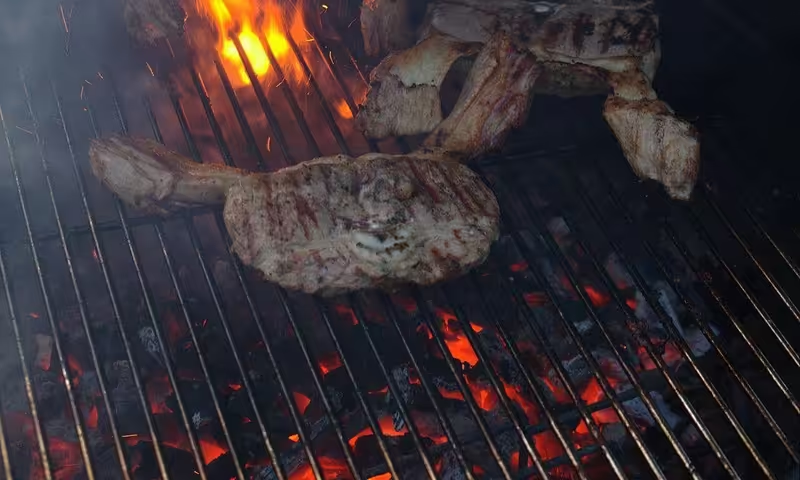
The method for freezing lamb chops
Wrap each chop individually — freezer paper or plastic pressed to the meat — then bag portions airtight. Individual wraps mean you thaw two chops for date night without disturbing the rest.
Before it goes in
- Freeze the chops fresh, within a day or two of purchase.
- Wrap each chop tightly, pressing the wrap against the meat.
- Bag the wrapped chops in meal portions — two, four, or six.
- Label with the cut and date; freeze flat on the coldest shelf.
Containers & wrapping
Freezer paper or vacuum bags are the classic answers; heavy freezer bags with the air pressed out do the same job. A rack of lamb freezes as a unit — overwrap it well and treat it like a small roast.
Freezer storage
4–6 months
Lamb chops hold quality 4–6 months frozen; a whole leg or shoulder tolerates up to 12, like other big roasts. Solidly frozen lamb stays safe at 0 °F / -18 °C — the window guards flavor.
Read the window on lamb chops as advice, not a warning. At 0 °F / -18 °C it is safe to eat at any age; 4–6 months is simply where the flavor and texture are worth the most.
Thawing lamb chops: the practical method
Refrigerator-thaw overnight; thick chops need a full day. Pat very dry before seasoning and searing. Sealed bags can take a cold-water bath in a pinch — cook immediately after.
Is a second freeze safe for lamb chops safely?
Acceptable if fridge-thawed and still cold, though the surface suffers; steer refrozen chops toward marinated or sauced preparations. A thawed rack is best roasted within a day.
Texture & flavor changes
Thawed chops sear nearly identically; the interior can run a touch looser and release more juice. A hard sear, a proper rest, and a bright sauce — mint or chimichurri — erase the difference for most tables.
Best uses after thawing
Where thawed lamb chops shines:
- Pan-seared chops
- Grilled chops
- Braised lamb
- Rack of lamb
- Chop salads
Which version are you working with?
Individual chops freeze in meal portions and thaw overnight; a whole rack or leg freezes as one piece and thaws over a day. Big cuts tolerate longer storage — chop early, roast later.
Caveats worth knowing
- Lamb's fat picks up freezer odors easily — vacuum seal or double-wrap if your freezer shares space with fish or onions.
- Gamey notes intensify slightly with long storage; within 4 months the chop tastes like itself.
Questions people ask about lamb chops
Can you freeze lamb chops?
Yes — 4–6 months at best quality. Wrap each chop individually, bag portions airtight, and freeze flat. Thaw overnight in the refrigerator, pat dry, and sear as usual; a well-wrapped chop comes back nearly indistinguishable from fresh.
Does lamb taste gamey after freezing?
Not within a sensible window — at 4–6 months well wrapped, lamb tastes like lamb. Beyond that, the fat can pick up freezer odors and the flavor can sharpen slightly. Airtight wrapping is the defense, and a bright herb sauce on the plate is the disguise.
How long should lamb chops stay in the freezer?
Four to six months for the best flavour; beyond that the fat starts to dull and any herbs in a marinade fade with it.
The details that decide it
Lamb mince is a formulated emulsion, and repeated cycling is what breaks it
A lamb chop is not an emulsion, but the mince and the patty made from it is, and that is where the freezer does its most specific damage. Standard practice mixes ground lamb with about two percent salt and ten percent ice water plus back fat, and the salt is what dissolves the myofibrillar protein so it can coat the fat droplets and hold the water. Work on that composite carried it through repeated freeze-thaw cycles and measured how the protein conformation, the emulsion stability and the gel properties changed together, finding that the cycles progressively undermine all three. Salt is doing two jobs at once here, and freezing partly reverses the one that matters: as the protein loses its folded shape, it can no longer hold the emulsion it had built.
- Ground lamb is formulated with roughly two percent salt and ten percent ice water.
- Salt dissolves myofibrillar protein so it can coat fat and hold water.
- Repeated cycles undermine conformation, emulsion stability and gel together.
The bond that fails in frozen lamb mince is hydrophobic, not ionic
The damage to a frozen lamb patty is not a vague softening; it is a specific change in which forces hold the protein together. The same study probed the gel with infrared spectroscopy, using the band near seventeen sixty inverse centimetres as a readout of hydrophobic interaction and the ratio of two other bands as a measure of hydrogen bonding, and watched the balance shift as freeze-thaw progressed. The mechanism is well understood: unfolding turns the protein non-polar regions outward, where they prefer to crowd together rather than face water, so hydrophobic association rises and the network that once bound water now binds itself. That is why a twice-frozen lamb patty can taste dry even after a gentle thaw, and why the fix is a formulation that keeps the protein folded rather than a thawing technique applied afterward.
- Infrared bands near seventeen sixty per centimetre report hydrophobic interaction.
- Freeze-thaw shifts the balance away from hydrogen bonding toward hydrophobic association.
- Unfolded protein crowds its non-polar regions together instead of holding water.
Two cycles and six cycles are not the same product, and the count is the reason
The number of freeze-thaw cycles behaves less like a threshold and more like interest on a loan. Reviews of frozen muscle describe repeated cycling as denaturing the myofibrillar proteins further with each pass, reducing water-holding capacity and increasing oxidation, and note that the reuse of ice crystals in each cycle mechanically damages what the previous cycle had already weakened. The myofibrillar fraction is the most susceptible, and each cycle exposes more of it. There is no single safe number of refreezes, because the same count lands differently on a lean chop and a fatty patty, but the direction is monotonic: every extra cycle takes something the last one had left. Treating the count itself as the variable is more useful than guessing at a storage date.
- Each cycle denatures myofibrillar protein further and reduces water-holding.
- Reused crystals damage tissue the previous cycle already weakened.
- There is no single safe refreeze count; the effect is monotonic, not a threshold.
Related foods