Can You Freeze Fish Sticks?
Fish sticks arrive from the factory already frozen, so this one is easy: your freezer is simply their natural habitat. The only real work is keeping the bag sealed against frost, skipping the thaw step, and trusting the oven to do its job.
Also called: breaded fish sticks · frozen fish sticks · battered fish portions · fish fingers
Yes — store-bought fish sticks are built for the freezer; keep them sealed, expect about 3 months of quality, and cook from frozen.
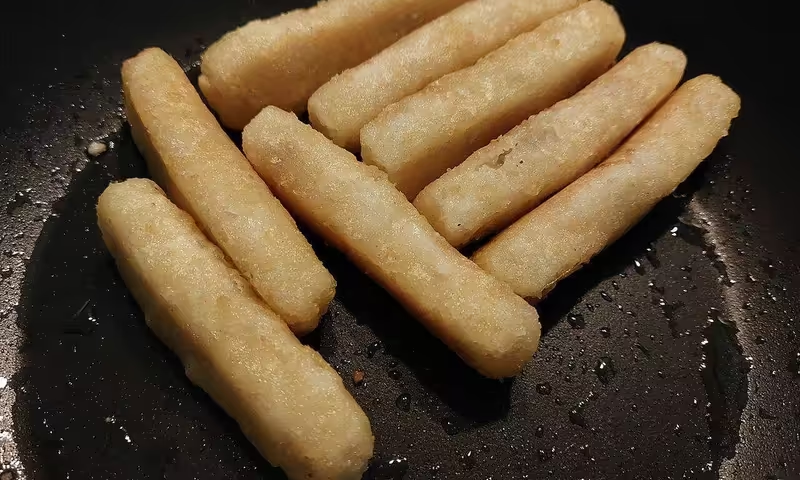
The best way to freeze fish sticks
Keep them in the original bag, rolled and clipped, or slide them into a freezer bag for extra frost protection. Cook straight from frozen — breaded coatings need the oven's full heat to crisp without steaming.
Before it goes in
- Check the seal on the original bag and press out the extra air.
- Transfer to a zip-top freezer bag if the package is torn or crush-prone.
- Store flat, away from the door, where temperature swings are smallest.
- Note the date — factory-frozen sticks count their quality months from production.
Containers & wrapping
Original packaging, rolled and clipped tight, or a heavy freezer bag. The breading pulls freezer odors if left open — sealed is crispy.
Freezer storage
3 months
Commercial freezing dates from production, not purchase — respect the printed date. Beyond three months the breading toughens and the fish inside dries.
Treat the storage window on fish sticks as a quality clock. Frozen solid at 0 °F / -18 °C it does not become unsafe with time; the window tells you when the eating starts to slip.
Thawing fish sticks without spoiling it
Do not thaw. Bake or air-fry straight from frozen at the package temperature; thawing loosens the breading and steams the fish before the crust can set.
Can fish sticks survive a second freeze safely?
Only if they never thawed — sticks that thawed in transit or on the counter should be cooked immediately and eaten, not returned to the freezer.
Texture & flavor changes
Well-sealed sticks reheat nearly identically to fresh from the bag, though the crust may lose a little shatter after several months. Frost-burned spots mean dry, mealy fish inside — trim and move on.
Best uses after thawing
Where thawed fish sticks shines:
- Oven baking
- Air fryer
- Fish sandwiches
- Weeknight plates
Which version are you freezing?
Store-bought sticks are flash-frozen and forgiving. Homemade breaded fish need a tray-freeze first so the coating sets solid, and they keep quality closer to two months.
Caveats worth knowing
- Cook from frozen, always — partial thawing bakes unevenly, and from frozen is both the safe and the crisp route.
- Open bags frost-burn within weeks; the seal is doing all the work here.
- Homemade breaded fish sticks freeze well too — tray-freeze first so the coating sets solid, and use within two months.
Questions about frozen fish sticks
Can you refreeze fish sticks?
If they stayed frozen the whole way home, the question never arises. Sticks that thawed in the refrigerator can be cooked and then refrozen as a finished dish; anything thawed at room temperature should be cooked immediately and eaten, not returned.
How long do fish sticks last in the freezer?
About three months for best quality, though they stay safe frozen solid well beyond that. After three months the breading toughens and the fish dries out — still edible, less happy.
Should I thaw fish sticks before baking?
No — bake them straight from frozen. Thawing loosens the breading and releases moisture, which steams the coating instead of crisping it. The oven time printed on the bag already assumes frozen sticks.
The details that decide it
A nugget fried before the freezer came through ninety days in better shape than one that was baked
A breaded fish portion is usually cooked once before it is frozen and once after, and the first cook sets how the frozen months go. Cassava fish nuggets were shaped from minced fish, blast-frozen at minus twenty-one for an hour and then held at minus eighteen for ninety days, some of them deep-fried at a hundred and sixty degrees and some oven-baked. Both methods held up; the fried ones held up better. Peroxide value after ninety days was 4.03 milliequivalents per kilogram of fat in the fried nuggets against 4.30 in the baked ones, and free fatty acids ran 1.02 to 1.46 per cent fried against 1.68 to 1.99 per cent baked, which the authors read as lipase activity that the frying heat and the oil migration had partly shut down. Total plate count fell in both, from 3.85 to 1.33 log CFU per gram in the fried nuggets, and the baked ones were higher at every point early in storage. Hardness tracked moisture content, not the cooking method.
- Peroxide value after ninety days was 4.03 in the fried nuggets and 4.30 in the baked ones.
- Free fatty acids ran 1.02 to 1.46 per cent fried against 1.68 to 1.99 per cent baked.
- Total plate count fell from 3.85 to 1.33 log CFU per gram in the fried nuggets over the ninety days.
An ice coating cut the frost and the drip on a fish ball through seven freeze-thaw cycles
Quick-frozen fish balls are the most cycled product in a home freezer, because they are taken out a handful at a time. This trial froze surimi balls at minus thirty, dipped half of them in chitosan solutions of half a per cent to two per cent, and then ran them through seven cycles of a week at minus eighteen and a four-hour thaw. The two per cent solution was too thick, laying down a coating rate of 31.9 per cent that ruined the appearance, so one and a half per cent was chosen. Against the uncoated balls it cut surface frost by 91 per cent after the first cycle, but the advantage shrank as the coating itself degraded, down to 40 per cent by the seventh. Thawing loss was 29.5 per cent lower at that seventh cycle, the free-water relaxation time was 17.4 per cent shorter, and the volatile base nitrogen that reached 30.30 milligrams per hundred grams in the uncoated balls, past the spoilage line, was 52 per cent lower under the coating.
- Frost on the coated balls was 91 per cent lower after the first cycle but only 40 per cent lower by the seventh.
- Thawing loss was 29.5 per cent lower in the coated group at the seventh cycle.
- Uncoated balls reached 30.30 milligrams of volatile base nitrogen per hundred grams by the seventh cycle.
A fruit powder kept the water in a frozen fish ball where the unsupplemented control lost a fifth of it
Fish balls made from pangasius were sealed and held at minus twenty for two months with nothing added, with a synthetic antioxidant, with ascorbic acid, and with one per cent fig powder, and the fig group came out ahead of the control on every water measure. Moisture of the control fell from 65.70 to 58.39 per cent, while the fig-powder balls went from 69.25 to 65.06, so the difference between the two grew from under four points to nearly seven. The pH of the control rose to 5.60 as the tissue broke down, against 5.38 in the fig group. Cooking loss at two months was 14.07 per cent for the control against 13.76 with fig powder, and the fig samples held their redness instead of browning. Malondialdehyde was lower in every supplemented batch, and the fig powder equalled the synthetic antioxidant on scavenging activity.
- The control lost moisture from 65.70 to 58.39 per cent over two months at minus twenty.
- The fig-powder balls finished at 65.06 per cent moisture and a pH of 5.38.
- Cooking loss at two months was 14.07 per cent in the control against 13.76 with fig powder.
Related foods