Can You Freeze Bread?
The freezer is where bread stops going stale. Frozen at its freshest, a loaf keeps its crumb and crust for months, and a single slice goes from solid to toast in the time it takes to brew coffee.
Also called: loaf of bread · sliced bread · sandwich bread · white bread · whole wheat bread
Yes — bread freezes beautifully for up to 3 months; slice it first and it toasts back to fresh in minutes.
Freezing bread the right way
Slice the loaf before freezing so you can pull pieces individually — thawing and re-slicing a whole frozen loaf mangles the crumb. Slide the sliced loaf into a double layer of freezer bags and toast slices straight from frozen.
Before it goes in
- Freeze the loaf while it is at peak freshness — the day you buy or bake it.
- Slice the loaf evenly; thin slices for toast, thicker ones for sandwiches.
- Slip the sliced loaf into a freezer bag in two layers to guard against freezer burn.
- Press out the air, seal, and label with the date.
- Store the bag flat in the freezer so slices stay separated and easy to pull.
Containers & wrapping
A freezer-grade zip bag is enough for short storage; for two months or more, wrap the loaf in plastic wrap and foil, or use two nested bags. The freezer replaces the bread box, not the other way around.
Freezer storage
3 months
Safety is never the issue at 0 °F; staleness and freezer burn are. Unopened store loaves with preservatives hold quality a little longer than dense artisan loaves.
Safe and good are two different clocks for bread: at 0 °F / -18 °C it stays safe as long as it is solidly frozen, and the 3 months window above is about eating quality.
How to thaw frozen bread
Toast slices straight from frozen — no thawing needed. For a whole loaf, thaw wrapped at room temperature for a few hours, then refresh the crust in a 350 °F oven for 5–10 minutes.
Is a second freeze okay for bread if you are careful?
Fine in a pinch if the bread is still frosty and was thawed in the refrigerator, but expect drier crumb. Refreeze once at most.
Texture & flavor changes
Thawed bread is nearly indistinguishable from fresh once toasted; the starches have only paused. Untoasted, the crust loses some crackle and the crumb reads a touch drier — a round of butter hides it.
Best uses after thawing
Where thawed bread shines:
- Toast
- Sandwiches
- Grilled cheese
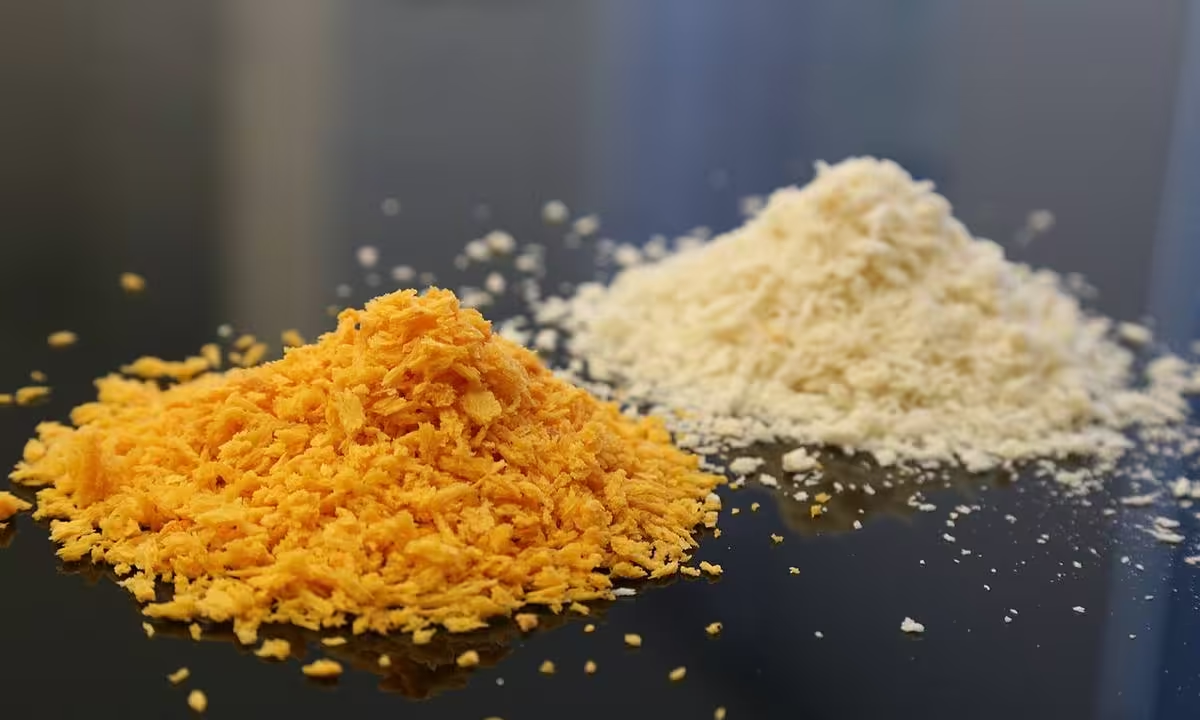
- Breadcrumbs
- French toast
Which version is going in the freezer?
Slice before freezing for everyday use; freeze a whole loaf only when you want a centerpiece, thawing it wrapped at room temperature and refreshing it in a hot oven for a crackling crust.
Preservative-bearing sandwich loaves hold quality a touch longer, while lean artisan and homemade breads stale fastest — freeze those within a day of baking.
Caveats worth knowing
- Freeze bread the day it is freshest — waiting until it stales locks in stale crumb rather than pausing freshness.
- Slices thaw fast at room temperature; a forgotten bag on the counter weeps condensation that sogs the crust.
- Store-bought loaves with preservatives outlast bakery bread in the freezer; plan on 3 months for anything without them.
Freezing bread: what readers ask
Can you freeze bread without slicing it first?
Yes, and a whole loaf keeps its moisture well — but you then commit to thawing all of it at once. Wrap it tightly in plastic and foil, thaw at room temperature for a few hours, and refresh in a 350 °F oven for 5–10 minutes to revive the crust. Slicing first is still more practical.
How long can you freeze bread?
Three months for best quality. Bread stays safe indefinitely at 0 °F as long as it remains frozen, but freezer burn and off flavors creep in past the three-month mark, especially on preservative-free loaves. Label the bag so you know when to rotate.
Can you eat frozen bread without thawing it?
Slices go straight into the toaster from frozen — that is the best move and takes seconds. Eating it plain, though, is a dry, crumbly experience; even a 20-second microwave softens a slice enough for a sandwich.
The details that decide it
A bacterial polymer at four tenths of a gram per kilo lifts a frozen-dough loaf by a fifth
Poly-gamma-glutamic acid is a water-soluble polymer that Bacillus bacteria excrete, and it turns out to be a cryoprotectant: it grips water so tightly that less of it can join the ice crystals that prickle through the gluten. This study made bread dough with wheat flour and added the polymer at 0, 0.1 and up to 0.6 grams per kilogram, then froze the dough fast at minus eighty for twenty minutes and held it at minus twenty for two and four weeks before thawing at four degrees and baking. At the best dose of 0.4 grams per kilogram the gains were large and grew with time. After two weeks the baked loaf had 16.0 per cent more specific volume and 36.4 per cent less hardness, with gumminess and chewiness down 32.9 and 31.9 per cent. After four weeks the same loaf had 21.3 per cent more volume and 38.3 per cent less hardness, with gumminess and chewiness down 36.7 and 34.6 per cent. The dough told the same story from the inside: its gas retention volume and gas retention ratio rose 31.3 and 11.1 per cent after two weeks and 37.3 and 13.1 per cent after four. The control dough still had 45.9 per cent of its water able to freeze after two weeks, and the polymer worked by keeping more of it out of the ice.
- At 0.4 grams per kilogram the baked loaf gained 16.0 per cent specific volume after two weeks.
- Hardness fell 36.4 per cent at two weeks and 38.3 per cent at four.
- Gas retention volume rose 31.3 per cent at two weeks, 37.3 at four.
A barley antifreeze protein slows the collapse of the loaf across four freeze-thaw cycles
Antifreeze proteins are made by organisms that survive sub-zero temperatures, and barley makes one called BaAFP-1. This study added it at 0.5 per cent of the flour weight and put the dough through a production freeze of two hours at minus thirty, then storage at minus eighteen with up to four freeze-thaw cycles, each thaw taken to fifteen degrees at the centre. A loaf left unprotected collapsed steadily. Its fermentation volume fell from 1233 millilitres fresh to 721 after four cycles, and its retention volume from 1111 to 692; with BaAFP-1 in the dough the same two measures fell from 1148 to 752 and from 1092 to 729. The maximum fermentation height dropped from 33.2 to 7.0 millimetres in the control but only to 11.2 with the protein. The crumb showed the ice damage as pores that multiplied and shrank: the control went from 508 pores averaging 125 square millimetres fresh to 1232 pores of 60 after four cycles, against 469 to 989 pores and 134 to 78 square millimetres with BaAFP-1. Proofing time stretched and specific volume fell in both doughs, but less in the one carrying the protein, and its crumb hardened more slowly.
- Control fermentation volume fell from 1233 to 721 millilitres across four freeze-thaw cycles.
- With the protein in the dough it fell only from 1148 to 752 millilitres.
- Control crumb pores doubled, 508 to 1232, while average area halved from 125 to 60.
A fish-skin gelatin hydrolysate cuts the freezable water that tears frozen bread dough
Bread dough frozen for weeks does not just lose volume; its gluten network depolymerises as ice recrystallises and water is pulled from bound to freezable. This study took gelatin from fish skin, broke it into peptides with two enzymes, alcalase and savinase, and added the hydrolysates to bread dough stored at minus thirty for thirty days, then thawed at four degrees for three hours before baking. The control dough degraded most: over the thirty days its loss tangent, the ratio of viscous to elastic behaviour that rises as gluten weakens, climbed 42.6 per cent, while the doughs carrying the hydrolysates climbed less. The freezable-water content told the same story: it rose 39 per cent in the control, but only 25 per cent with the alcalase hydrolysate, 26 per cent with the savinase one, and just 9.4 per cent when the two were combined. After storage the loaves baked from dough with the single hydrolysates kept the largest specific volume and the lowest hardness, and the hydrolysates individually slowed the depolymerisation of the gluten proteins, though combining the two did not help the finished bread.
- Control loss tangent climbed 42.6 per cent across the thirty days at minus thirty.
- Freezable water rose 39 per cent in the control against 25, 26 and 9.4 treated.
- The single hydrolysates kept the largest loaf volume and the lowest hardness.
Related foods