Can You Freeze Mango?
Mango is the reason frozen fruit exists: peak-season flavor, no peel drama, cubes that pour straight into a blender. Freezing your own from a ripe fruit costs a fraction of the bagged kind and tastes better for it.
Also called: fresh mango · frozen mango chunks · mango cubes
Yes — mango freezes beautifully in tray-frozen chunks and thaws as smoothie-perfect, salsa-ready fruit that barely seems frozen at all.
How to freeze mango at its best
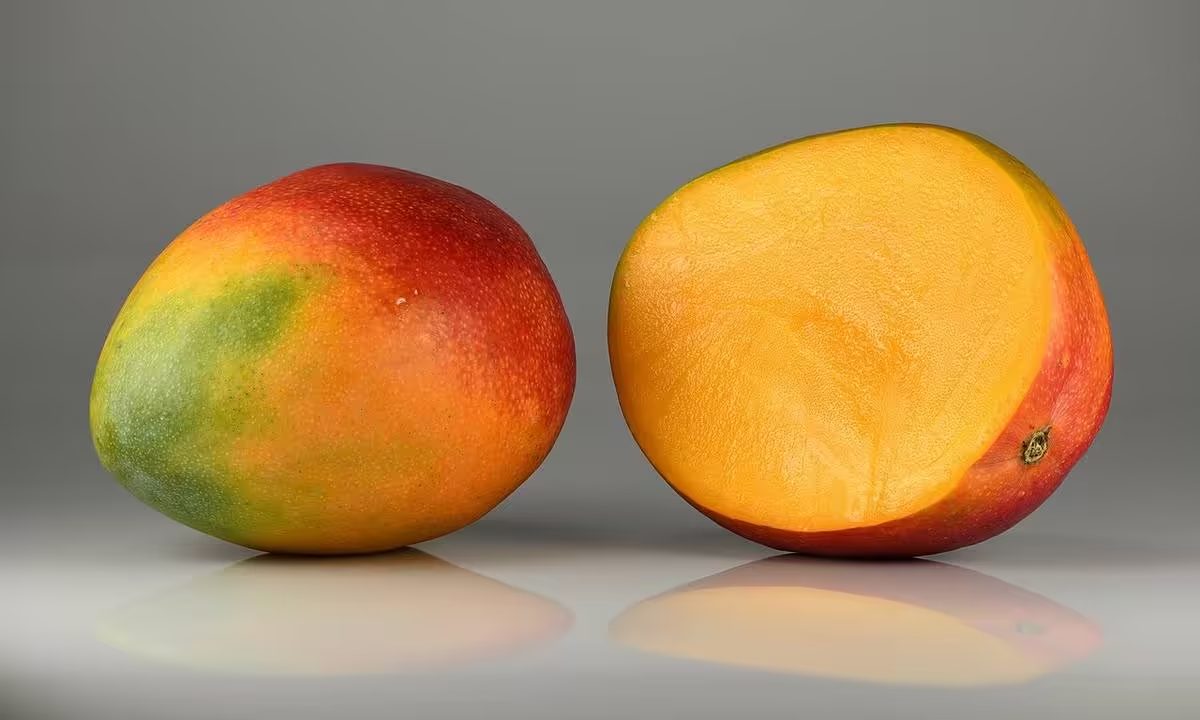
Peel, cut the flesh away from the pit, and cube, then freeze in a single layer on a tray before bagging. Mango chunks freeze into loose, pourable pieces that go straight from bag to blender or salsa bowl.
Before it goes in
- Choose fruit that gives gently at the shoulders and smells sweet at the stem end.
- Peel with a knife or vegetable peeler and slice the cheeks away from the flat pit.
- Cut into even chunks, roughly an inch, so they freeze and thaw at the same rate.
- Spread on a parchment-lined tray, freeze until solid, then pour into bags with the air pressed out.
Containers & wrapping
Freezer bags after the tray-freeze; lay them flat and label clearly. Rigid containers work but take up space. Chunks are sturdy, so no special protection is needed.
Freezer storage
8–12 months
Flavor holds remarkably well; the only real fade is a slightly duller tropical perfume after six months or so. Rotate older bags into sauces and lassi where it hides.
Cold does not make mango dangerous over time. Held at 0 °F / -18 °C it remains safe indefinitely, and the window above is an honest estimate of when texture starts to go.
Thawing mango the right way
Usually unnecessary — frozen mango goes straight into smoothies, lassi, and salsa (diced small while frozen). To thaw, a few hours in the refrigerator; it softens without collapsing into water.
Can you refreeze mango if you are careful?
Only if it stayed refrigerated and frosty. Thawed mango gets noticeably softer and wetter; a second freeze pushes it toward fibrous and bland.
Texture & flavor changes
The texture softens a step — thawed mango is silkier and slightly wetter than fresh, and the fibers soften too. Flavor stays true. It still cubes neatly frozen and blends perfectly; it just will not stand up on a cheese board.
Best uses after thawing
Where thawed mango shines:
- Smoothies
- Mango salsa
- Lassi
- Sauces and curries
- Frozen snacking
Caveats worth knowing
- Underripe mango never develops flavor in the freezer — freeze fruit that is actually ripe and fragrant.
- Skip the sugar-syrup packing; ripe mango needs nothing and syrup masks the flavor you were saving.
- The fibers near the pit soften into strings when thawed — cut generously away from the pit when prepping.
Mango freezer questions
Can you freeze fresh mango chunks?
Yes — peel, cube, tray-freeze in a single layer, and bag. The chunks stay loose and pourable, ready for smoothies or salsa straight from the freezer. It is every bit as good as store-bought frozen mango, often better from ripe fruit.
How long can you freeze mango?
Eight to twelve months for best quality; it stays safe while solidly frozen at 0 °F. The tropical perfume fades slowly after about six months, so older bags are best in sauces or blended drinks.
Do you need to thaw frozen mango before blending?
No — frozen mango chunks blend straight from the freezer and actually make smoother, thicker smoothies. If your blender struggles, let the chunks sit for five minutes or add a splash of liquid first.
The details that decide it
A 300-watt microwave thaw clears a frozen mango in forty-eight seconds and costs it the least
The thaw is where a frozen mango either keeps what the freezer put into it or gives it back, and the speed of the thaw decides most of that. This study froze the fruit at minus forty degrees for a full day in hundred-gram bags, then compared two conventional and two modern returns: air and water held at twenty degrees, microwave at 100, 200 and 300 watts, and ultra-high-pressure water at 75, 100 and 125 megapascals. Air needed about twenty-eight minutes to bring the centre to zero and water six minutes; the microwave finished in three minutes at 100 watts and in 48.8 seconds at 300, while the three pressure levels ran 72.9, 64.5 and 69.5 seconds. Speed translated straight into quality. The 300-watt pass lost the least water, bottoming out at 3.58 per cent drip, held its firmness best and kept the highest vitamin C of any method; air and water left the flesh softer, vitamin C fell as the pressure rose, and colour held at 75 and 100 megapascals but broke at 125, where the colour difference reached 12.67. The sensory panel agreed with the instruments.
- Air needed twenty-eight minutes and water six; the 300-watt microwave finished in 48.8 seconds.
- At 300 watts drip bottomed at 3.58 per cent, with firmness and vitamin C best kept.
- 125 megapascals cost the most colour, a delta E of 12.67.
Two months at minus eighteen hardly grow the ice in a mango, and a prior freeze shortens the drying
Freezing is a decision made before storage, and this study let the storage run while the fruit waited to be dried. Slabs were frozen two ways - slowly in a conventional freezer at minus eighteen, quickly in an air-blast at minus forty - with the middle pulled all the way down to minus eighteen, and parked there for one and two months before an osmotic soak in a 38 degree Brix sugar solution and hot-air drying at 50 and 60 degrees. Freezing paid off at the dryer: against fresh slabs the time to constant weight fell about 16 and 26 per cent at 50 degrees for the quick and slow freezes, and 5 and 16 per cent at 60, where the run took 19 hours fresh, 18 quick-frozen and 16 slow-frozen. The frozen state then rode out the wait. Ice in the rubbery flesh crept only from about 120 to 136 micrometres across two months, cell structure damage did not significantly increase, and the phenolics held their ground; one and two months of storage also pulled the sugar-solution equilibrium down to fourteen hours, and the dried product came out harder the longer the fruit had stayed frozen.
- The 60-degree drying run took 19 hours fresh, 18 quick-frozen and 16 slow-frozen.
- Two months at minus eighteen grew the ice only from 120 to 136 micrometres.
- Structure damage and phenolics held; the dried slab finished harder the longer it froze.
A freeze-thaw doubles the sugar a mango takes in during osmotic dehydration, and polysaccharides push it back
Pretreatment decides how much of the outside world a mango slab will drink, and this study pitted the most destructive route against the gentlest. Cubes were frozen at minus thirty-six for two weeks and thawed a day at four degrees - the freeze-thaw that tears cell membranes - while others got pulsed electric fields of 10 or 30 pulses at one kilovolt per centimetre, with fresh cubes as the control; all of them then went into sucrose-fructose baths at 40 degrees, plain or carrying inulin, or inulin with xanthan gum. The freeze-thaw doubled what the flesh absorbed: finished sugar contents of 27.42, 22.68 and 11.08 per cent against the fresh 14.88, 8.74 and 10.84 across the three baths. The electric field barely nudged uptake at either dose, because its pores stay small while freeze-thaw ice ruptures the membrane outright, and the disintegration index records that difference. Adding polysaccharide closed the gap: in the inulin-and-xanthan bath the freeze-thawed cubes finished within reach of fresh behaviour, at 11.08 per cent against 10.84.
- Freeze-thawed flesh finished at 27.42 per cent solids where fresh flesh finished at 14.88.
- Pulsed electric fields at either dose barely moved sugar uptake.
- Polysaccharide in the bath closed the gap, 11.08 per cent against the fresh 10.84.
Related foods