Can You Freeze Ice Cream?
Ice cream starts frozen, so the real question is not whether it can go in the freezer but how long it stays good there. The enemies are air, warmth swings, and time: manage those and a pint keeps its texture for weeks longer than the tub ever survives in the house.
Also called: gelato · icecream · frozen dessert · ice cream pint
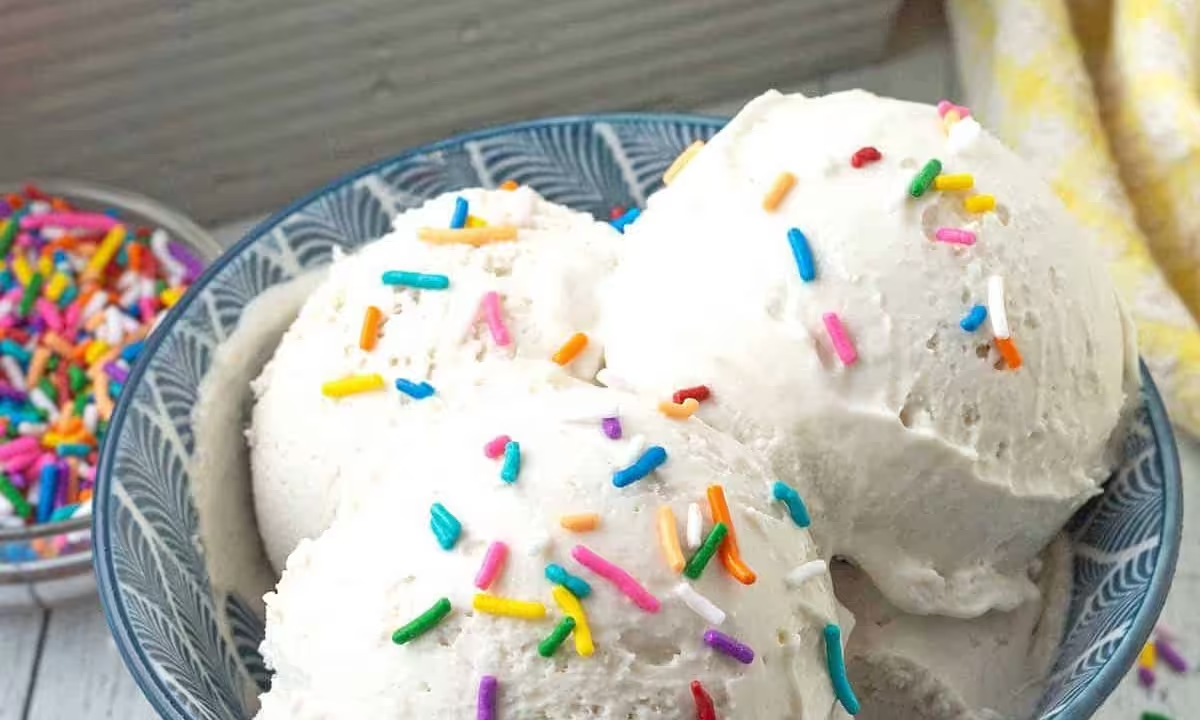
Yes — ice cream belongs in the freezer; kept sealed and undisturbed it stays creamy for about 2 months.
How to get ice cream into the freezer
Store it cold and undisturbed: a sealed airtight container with plastic wrap pressed against the surface, kept at the back of the freezer where the temperature never wavers. A sheet of plastic on top is the difference between creamy and icy.
Before it goes in
- Press a piece of plastic wrap directly onto the surface of the ice cream to block air.
- Snap the lid on tightly or transfer the pint to a shallow airtight container.
- Place it at the back or bottom of the freezer, never in the door.
- Keep the freezer at 0 °F or below; warmer settings slowly grow ice crystals.
Containers & wrapping
Shallow airtight containers beat deep tubs — less air space, faster to re-freeze after scooping. The original pint works fine once opened if you add the surface wrap and close it properly.
Freezer storage
2 months
Best quality in the first month or two. Every trip out of the freezer lets ice crystals restart, so the more the container is opened, the icier it becomes.
Treat the storage window on ice cream as a quality clock. Frozen solid at 0 °F / -18 °C it does not become unsafe with time; the window tells you when the eating starts to slip.
How to bring ice cream back
None — ice cream is eaten frozen. For clean scoops, temper the container in the refrigerator for 10–15 minutes until it gives to a spoon without melting at the edges.
Can you re-freeze ice cream safely?
Only if it never fully melted. Ice cream thawed to slush and refrozen turns icy and grainy, and a carton left fully melted at room temperature is as much a safety question as a quality one — in that case, discard it.
Texture & flavor changes
Over time the small ice crystals merge into bigger ones and the texture turns from silky to crumbly and snow-like. Flavor holds up better than texture, which is why slightly old ice cream still makes a perfectly good milkshake or affogato.
Best uses after thawing
Where thawed ice cream shines:
- Sundaes
- Milkshakes
- Affogato
- Ice cream sandwiches
- Blended frappés
Which version are you freezing?
Store-bought ice cream is engineered with stabilizers and overruns of air that help it survive fluctuating temperatures. Homemade batches, especially egg-free ones, need the coldest shelf and the tightest lid to stay creamy.
Gelato has less air and less fat, so it shows temperature swings sooner and turns dense and icy faster. American-style ice cream with more air tolerates storage a little better but never recovers from a full melt.
Caveats worth knowing
- A carton that fully melted at room temperature should be thrown out — the dairy base sat warm, and refreezing will not undo that.
- Door storage is the fastest route to icy ice cream; every opening warms the tub and the melt-refreeze cycle compounds.
- Homemade ice cream without commercial stabilizers turns icy faster than store-bought, so aim to eat it within a month.
Freezing ice cream: FAQs
Can you refreeze melted ice cream?
Not once it is fully melted. Slush that stayed cold can go back with only a texture penalty, but a completely liquid carton has sat in the danger zone for bacteria and will refreeze into an icy block. When in doubt, throw it out.
How long does ice cream last in the freezer?
About two months at peak quality, longer while still safe. It stays good indefinitely at a steady 0 °F, but ice crystals grow and the texture turns crumbly the longer it sits and the more often the container is opened.
Why did my ice cream get icy and crunchy?
Temperature fluctuations. Every time the tub warms slightly and refreezes, melted water re-forms into larger crystals. Store ice cream deep in the freezer with plastic pressed on the surface, and the crunch arrives much later.
The details that decide it
At 150 per cent overrun the emulsifier, not the protein, decided whether the fat held the melt together
Air is the ingredient a freezer adds, and above half the volume of a high-overrun ice cream is air, so the air phase has to be stabilised during freezing or it collapses in the tub. This study froze mixes at twelve per cent fat and a fixed freezing point of minus two point six zero degrees, built from milk protein concentrate, sodium caseinate or whey protein isolate, with and without a mono and diglyceride emulsifier at 0.15 per cent, then hardened them at minus twenty-nine for at least two hours and stored them there. Air input was set to reach either 100 or 150 per cent overrun. Adding the emulsifier significantly increased fat destabilisation in the milk protein concentrate and whey protein isolate desserts, showing as a particle peak between 30 and 100 micrometres, and it reduced the mean air cell size in those two proteins but had no effect on the sodium caseinate desserts, which the authors read as the non-micellar casein having its own interfacial behaviour. The fat scaffold that formed from that destabilisation was what delayed drip onset, because the globular whey proteins and the casein micelles were displaced from the interface while the flexible caseins were not.
- The mixes were built at twelve per cent fat with the freezing point pinned at minus two point six zero degrees.
- Mono and diglycerides were dosed at 0.15 per cent of the mix.
- The fat particle peak reached 30 to 100 micrometres in the milk protein and whey desserts only.
A light ice cream with inulin beat the full-fat control on overrun, firmness and viscosity
Cutting fat out of ice cream normally costs body, and this trial tested whether inulin and extruded microparticulated whey proteins could buy it back. The light mixes carried six per cent fat against a control at twelve, with microparticles sized between 0.1 and 10 micrometres, and two different process designs were run so the effect of how the mix was made could be separated from what was in it. Melting was measured after eight days at minus eighteen and texture after fourteen. The inulin treatment came out ahead of the full-fat control on all three of overrun, firmness and viscosity, and its melting behaviour was comparable, which the authors attribute to the high degree of polymerisation of the inulin and the microcrystals it forms when it dissolves in milk. The whey microparticles mostly went the other way and lowered overrun, and the two treatments with the least air were the firmest. The regression across the whole set was tight: protein content correlated with melting behaviour at r of 0.74 and negatively with viscosity at r of minus 0.63.
- The light mixes carried six per cent fat against a twelve per cent full-fat control.
- The extruded whey microparticles measured between 0.1 and 10 micrometres.
- Protein correlated with melting at r of 0.74 and negatively with viscosity at r of minus 0.63.
Oat beta-glucan held a whey ice cream crystal at 16.31 micrometres and pushed overrun past eighty per cent
Whey ice cream is the hard case for a freezer, because its high lactose and free water and its low fat leave the structure open to recrystallisation, so this study set oat and yeast beta-glucans against a commercial stabiliser in a whey-based mix. The standard stabiliser, Cremodan SI 320 at 0.6 per cent, lowered the freezing point to minus 2.74 degrees and held the mean crystal size at 20.50 micrometres after one week. The oat beta-glucan at 0.25 to 0.5 per cent matched that on the freezing point, reaching minus 2.81 degrees, and beat it on the crystals: the half per cent sample kept a fine initial structure with an X50 of 16.31 micrometres. It also carried more air, with overrun up to 81.52 to 83.12 per cent, against 76.74 to 77.39 per cent for the yeast beta-glucan, which the authors explain by the greater solubility and viscosity of the oat fraction trapping and stabilising the bubbles. Everything was hardened and then stored at minus eighteen for one month, in mixes that ran 42.05 to 42.24 per cent solids.
- The standard stabiliser worked at 0.6 per cent and held crystals at 20.50 micrometres after one week.
- Oat beta-glucan at half a per cent gave an X50 of 16.31 micrometres.
- Oat overrun climbed to 81.52 to 83.12 per cent while yeast sat at 76.74 to 77.39.
Related foods