Can You Freeze Blueberries?
Buy a flat at the height of the season, and it becomes winter's baking stash in twenty minutes of work. Blueberries barely complain about freezing — the skins hold, the flavor stays, and they pour loose straight from the bag.
Also called: berries · fresh blueberries · frozen blueberries · wild blueberries
Yes — blueberries are the easiest berry to freeze: rinse, dry, tray-freeze, and they come back perfect for muffins, pancakes, smoothies.
How to get blueberries into the freezer
Rinse, dry completely, and spread in a single layer on a tray until rock solid, then bag. The dry-surface tray step is what keeps them loose instead of frozen into a lump.
Before it goes in
- Rinse the berries in a colander and pick out stems, shriveled ones, and any mush.
- Dry thoroughly — spread on a towel for an hour; surface water makes ice skins.
- Freeze in a single layer on a parchment-lined tray until solid, two to three hours.
- Pour the frozen berries into bags or containers and squeeze out the air.
Containers & wrapping
Freezer bags are ideal once the berries are individually frozen — they store flat and pour like marbles. Rigid containers work too and protect against crushing at the bottom of a crowded freezer.
Freezer storage
8–12 months
Skins stay intact for a year, but flavor peaks around the six-month mark; older berries belong in batter where a little dullness hides.
Read the window on blueberries as advice, not a warning. At 0 °F / -18 °C it is safe to eat at any age; 8–12 months is simply where the flavor and texture are worth the most.
How to thaw blueberries for the best texture
Mostly unnecessary — frozen blueberries go straight into pancake and muffin batter, or the blender. To thaw, a few hours in the refrigerator.
Can you return blueberries to the freezer after thawing safely?
Only if still frosty from the refrigerator. Thawed blueberries weep and wrinkle, and a second freeze turns them soft and leathery.
Texture & flavor changes
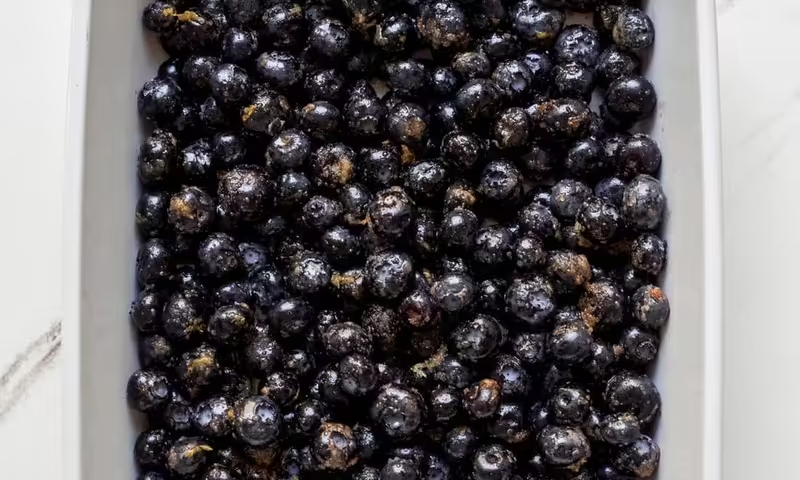
Blueberries come through the freezer better than any other berry — skins stay taut and the berries hold their shape. Thawed, they are a little softer with juice bleeding blue; baked or blended, you cannot tell them from fresh.
Best uses after thawing
Where thawed blueberries shines:
- Muffins
- Pancakes
- Smoothies
- Compote
- Cereal topping
Caveats worth knowing
- Wet berries freeze into a frosted clump and ice-burn — dry them properly before the tray.
- Dropping frozen blueberries straight into thin batter makes them sink and bleed; a quick flour toss prevents both.
- Store-bought clamshells are not freezer-safe long-term; move the berries to bags once solid.
Questions about frozen blueberries
Do you need to wash blueberries before freezing?
Yes — rinse, then dry them completely. Moisture on the skins forms ice crystals that rupture the skin and glue berries together. A full hour spread on a kitchen towel is the difference between pourable frozen blueberries and one frosty lump.
How long can you freeze blueberries?
Eight to twelve months for best quality; they stay safe indefinitely at 0 °F while frozen solid. Flavor slowly fades after six months, so steer older bags toward muffins and compote where brightness matters less.
Can frozen blueberries be used straight from the freezer in muffins?
Yes, and they hold their shape better that way — thawed berries bleed into the batter. Toss them in a spoonful of flour first so they do not sink, and add a minute or two to the bake time.
The details that decide it
A magnetic field over the freeze and a seventy-two-hour hold at minus eighteen moved the acids
A blueberry is a thin-skinned bag of juice, so the speed of the freeze sets how much of its cell wall survives, and this study tested two ways to speed it up. Berries were either frozen straight in a minus-twenty cabinet or pretreated with ultrasound and then frozen in a cabinet carrying a static magnetic field, and every frozen group was then held at minus eighteen for seventy-two hours before analysis. The antioxidant assays on the frozen berries are the point: the field and the ultrasound are both meant to make finer ice and waste less of the anthocyanins and phenolics that give the fruit its colour and its value. The ultrasound itself ran at fifty kilohertz and two hundred watts for five minutes, and the organic acid profile separated the treatments, with citric acid falling against fresh fruit in every frozen group while the ultrasound groups held it higher than the field-only ones.
- The berries were frozen at minus twenty, then held at minus eighteen for seventy-two hours.
- The ultrasound ran at fifty kilohertz and two hundred watts for five minutes.
- Citric acid fell against fresh fruit in every frozen group, least in the ultrasound ones.
How you thaw a blueberry decides how much ascorbic acid and aroma come back with it
Frozen berries are almost never eaten frozen, so the thaw is part of the storage, and this study followed the whole route from a minus-twenty cabinet to the plate. Berries about fifteen millimetres across were frozen at minus twenty and then thawed four different ways: plain air, air aided by a ten-millitesla magnetic field, plain water, and water aided by the same ten-millitesla field, with fresh fruit as the reference. Total soluble solids, titratable acidity, ascorbic acid and the sugar-to-acid ratio were tracked, and the volatile profile was read by gas chromatography and an electronic nose. The vitamin C is the fragile one, because it oxidises as the fruit warms, and the flavour compounds that read as fresh are largely the green six-carbon aldehydes, which the thaw drives off; the magnetic-field routes were tested precisely because a faster, more even thaw leaves more of both behind.
- The berries averaged fifteen millimetres across before freezing at minus twenty.
- Four thawing routes were compared, two of them aided by a ten-millitesla field.
- The volatile analysis tracked the green six-carbon aldehydes that read as fresh.
An edible coating made the frozen berry surface itself hostile to Salmonella and norovirus
Freezing stops microbes growing but does not kill them, so a berry that carried Salmonella or norovirus into the freezer still carries it out, and a coating can act where the freezer cannot. This study blast-froze berries in liquid nitrogen for thirty minutes, then held them at minus eighteen for one, two, three, four and eight weeks, counting bacteria and virus directly without thawing. The coating was built from carvacrol and citral, the two most studied antimicrobial essential-oil components, held in a matrix because both evaporate otherwise. On strawberries it cut Salmonella enterica by nearly three logarithmic units in the first week and drove the count below the detection limit by the eighth, while on blueberries the same coating brought the bacterium near the detection limit after a single week. The norovirus surrogate proved harder: infectivity fell only about two logarithmic units by the end, because a virus is not a bacterium and the coating disrupts it less.
- The fruit was blast-frozen in liquid nitrogen for thirty minutes, then held at minus eighteen for one to eight weeks.
- On strawberries the coating cut Salmonella enterica by nearly three logarithmic units in the first week.
- The norovirus surrogate fell only about two logarithmic units by the end of the storage.
Related foods